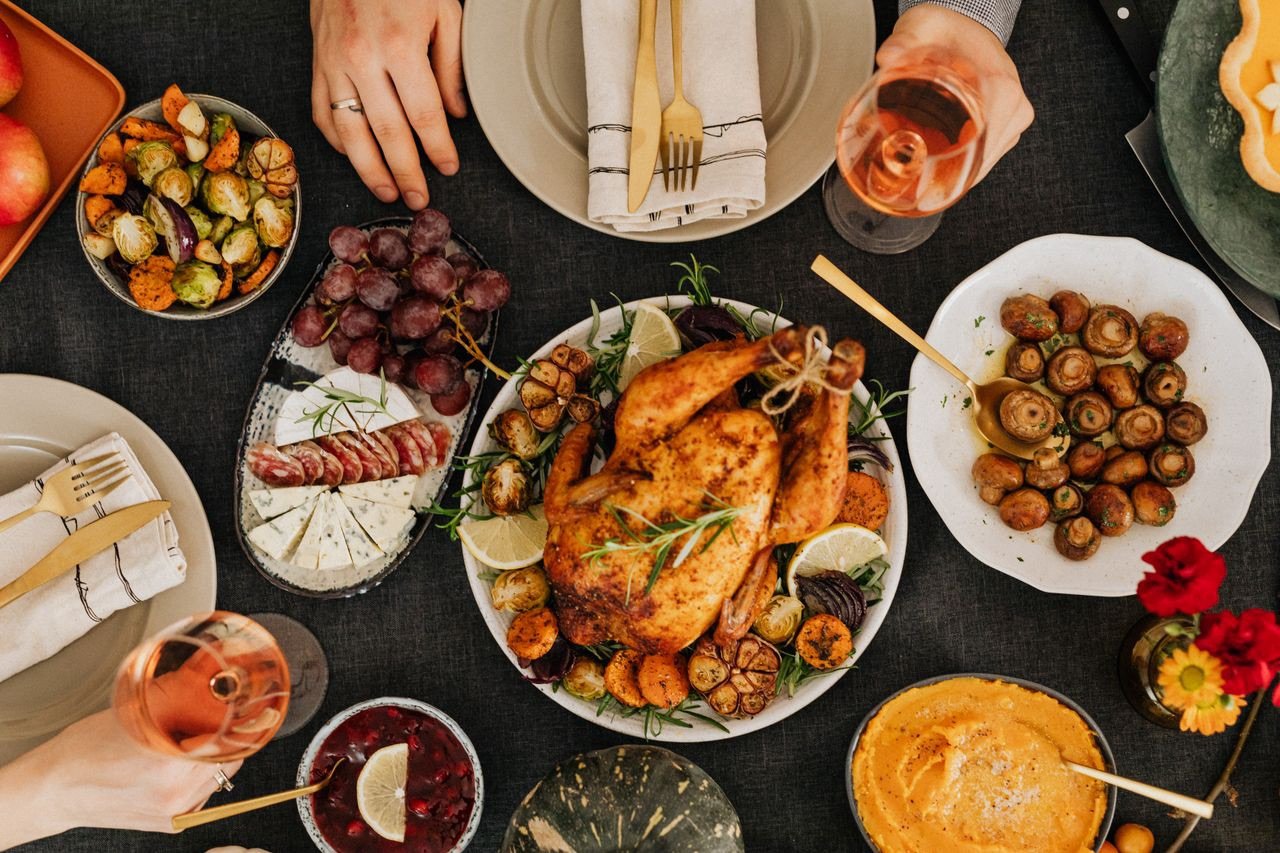
Thanksgiving menu planning for a table with carnivore, pescetarian, and vegetarian guests comes down to one shift: build the meal around shared sides everyone can eat, then swap in just one protein per diet instead of cooking three separate dinners.
Most of a Thanksgiving table is already accidentally friendly to every diet at it. The candied yams, the creamed corn, the potatoes, even the cranberry sauce, none of that needs to change no matter who’s sitting down this year. The only real planning happens around the protein, and that’s two or three dishes, not an entire second kitchen.
I found this out the hard way a few years back, the same year my sister-in-law went pescetarian and my cousin’s fiance went vegetarian. I panicked and started sketching three completely separate menus on a legal pad. I got about four dishes deep into the “vegetarian menu” before I realized half of it was just my normal Thanksgiving sides with a different label on top.
Below is exactly how I build this table now. Which sides need zero changes, which two recipes need one ingredient swapped, and the three proteins, real turkey, a slow-roasted whole side of salmon, and one vegetarian option for tables where the sides alone don’t feel like quite enough of a plate. I’m also giving you the actual portion math so nobody’s guessing how much salmon to buy.
Table of Contents
Key Takeaways
- Nearly every classic Thanksgiving side, from candied yams to au gratin potatoes, is already vegetarian with zero changes needed
- Only two dishes on a normal table, wild rice stuffing and cornbread dressing, need one swap (vegetable stock instead of chicken or turkey stock) to go fully vegetarian
- A slow-roasted whole side of salmon covers the pescetarian plate without turning into its own separate cooking project
- Southern green beans made the traditional way stay on the carnivore side of the table unless you use the vegetable broth version
- Plan on about 1.25 pounds of raw turkey per carnivore guest and roughly 6 ounces of salmon per pescetarian guest
- A vegetarian guest can eat a full plate off the shared sides alone, or you can add a stuffed squash if you want something on the table that reads more like a main
The Sides Everyone at the Table Can Already Eat
This is the part that surprised me most once I actually sat down and counted. Seven of my regular Thanksgiving sides need absolutely nothing done to them for a vegetarian or pescetarian guest to eat a full plate off of them.
| Side dish | Diet status |
| Candied Yams | Vegetarian as written |
| Candied Carrots | Vegetarian as written |
| Homemade Creamed Corn | Vegetarian as written |
| Sweet Potato Casserole | Vegetarian as written |
| Au Gratin Potatoes | Vegetarian as written (dairy) |
| Garlic Cauliflower Mash | Vegetarian as written |
| Spicy Cranberry Sauce | Vegetarian as written |
Two more dishes need one small change, not a rewrite. My wild rice stuffing with cranberries and pecans already has a vegetable stock option built right into the recipe’s stock comparison table. Swap the chicken stock for vegetable stock and the whole dish goes vegetarian, no other change needed.
Cornbread dressing is trickier, because it’s not automatically vegetarian just from looking at it. The classic version leans on chicken or turkey stock along with three eggs to bind everything together. The eggs stay either way, but I always swap in vegetable stock when there’s a vegetarian at the table, since that stock is the actual meat product hiding inside what otherwise looks like a plant-based casserole.
Southern green beans are the one dish on my table that doesn’t quietly work for everyone. The long simmer that makes them so good comes from bacon or ham hock rendering into the broth for close to an hour, so as written, this one stays on the carnivore side. My own recipe has a vegetable broth and smoked paprika version built in for a meatless take with some real depth to it, but I’ll be honest, it’s a different dish, not a dead ringer for the original.
Turkey gravy stays firmly in the carnivore column too, since it’s built from real pan drippings. I don’t bother trying to fake a vegetarian version. Nobody’s actually asking for that, they’re asking for their own protein and a plate of sides that already work for them.
If you want the full lineup with all nine of my go-to sides in one place, I keep them together in my Thanksgiving side dish roundup.
The Three Protein Swaps, Not Three Different Dinners
Once the sides are settled, the whole project shrinks down to three proteins instead of three menus. This is how I handle each one now.
Carnivore: A Real Turkey
This one doesn’t need reinventing. A roasted turkey is still the centerpiece for anyone eating meat, and my turkey gravy recipe covers the part people actually stress about on the day, getting real flavor out of the pan drippings instead of pouring from a jar.
For portioning, I plan on about 1.25 pounds of raw turkey per carnivore guest. That number accounts for bone weight and the water that cooks out, not just what ends up on the plate. If you want real leftovers, bump that up to 1.5 pounds a person.
A 12-pound turkey covers about 9 to 10 carnivore guests using that math, which matters here since you’re not also stretching the same bird to feed the vegetarian or pescetarian half of the table. A sturdy roasting pan with a rack makes it easier to get the bird out evenly browned on the bottom too, not just the top.
Pescetarian: Slow-Roasted Whole Side of Salmon
The pescetarian plate is the one that used to make me panic, and I get why it trips people up. Fish is easy to overcook, and most people’s only frame of reference is a quick pan-seared fillet, which doesn’t really scale up to a table of six or eight guests.
What actually fixed this for me was switching to a whole side of salmon, cooked low and slow instead of hot and fast. I dry brine it almost the same way I’d dry brine a turkey, salt rubbed on the flesh side, left uncovered in the fridge for an hour or two, which firms up the texture and seasons it all the way through instead of just on the surface.
The oven does the rest. I brush the top with honey and run it under the broiler for about 10 minutes until it’s lightly browned, then drop the temperature all the way down to 250°F and let it finish low and slow until the center reads somewhere between 125°F and 130°F.
The FDA’s official safe minimum for fish is 145°F, so if you’d rather play it safer, pull it there instead. It just won’t be quite as silky in the middle.
A rimmed sheet pan lined with a heavy-duty foil sling underneath makes it possible to lift the whole thing onto a serving platter in one piece instead of it falling apart on you, which happened to me exactly once before I started doing it this way.
A 2.5 to 3 pound side of salmon feeds about six people at roughly 6 ounces a person as a main course portion. For a bigger table, I just cook two sides instead of hunting for one giant piece of fish, since two smaller pieces actually cook more evenly anyway. I’ve got the full recipe, ingredients and all, at the bottom of this post.
Vegetarian: When the Sides Aren’t Quite a Full Plate
Out of the three, the vegetarian guest is honestly the easiest to plan for, and also the one most likely to end up with a plate of nothing but side dishes if no one thinks about it on purpose.
Most years I don’t add anything extra. Between the cauliflower mash, the potatoes, the swapped stuffing, and the cranberry sauce, that’s already a full plate with real substance to it, and not vegetables pushed to the side of someone else’s dinner.
If I’ve got more than a guest or two who are vegetarian, or I just want something on the table that reads more like a main course, I roast acorn squash halves and fill them with my wild rice stuffing with cranberries and pecans, made with the vegetable stock swap. The squash goes cut-side down on a sheet pan at 375°F for about 35 to 40 minutes, until a knife slides through easily. I flip it, pack the warm stuffing into the center, and slide it back in for another 10 minutes to warm through and pick up a little color on top.
It looks like it took a lot more effort than it actually did, since the stuffing recipe is already written and I’m just using the squash as an edible bowl for it.
How I Actually Build This Table
The oven is the real bottleneck here, not the number of dishes. Turkey usually roasts somewhere between 325°F and 425°F depending on the method, and salmon wants a cool 250°F, so the two can’t share oven space at the same time.
What I do is time the salmon for the turkey’s resting window. Once the turkey comes out and gets tented in foil to rest for 30 to 45 minutes, the oven is free, so I drop the temperature and slide the salmon in right then. It finishes cooking in almost exactly the window the turkey needs to rest, so nothing sits around getting cold.
If you’re mapping the whole day out hour by hour, my Thanksgiving hosting timeline is the schedule I actually build everything else around, turkey included. For the vegetarian sides and the stuffed squash, I stagger those into whatever oven space opens up before and after the turkey, same as any other year. Nothing about a mixed table changes how I sequence the sides themselves.
What Each Guest’s Plate Actually Looks Like
Once everything’s cooked, this is roughly how the same table splits across three plates without anyone eating a noticeably smaller dinner than anyone else.
| Diet | Protein | Sides |
| Carnivore | Turkey and gravy | All shared sides, plus southern green beans and the stock-based stuffing or dressing |
| Pescetarian | Slow-roasted salmon | All shared sides, plus the vegetable-stock stuffing and dressing, minus southern green beans unless it’s the meatless version |
| Vegetarian | Shared sides alone, or the stuffed acorn squash | All shared sides, plus the vegetable-stock stuffing and dressing, minus southern green beans unless it’s the meatless version |
Portion Planning for a Mixed Table
Confirming headcount and dietary needs is the first line item on my hosting timeline, and it matters even more on a mixed table since it’s what decides how much salmon and turkey you’re actually buying, not only how many chairs to set out.
| Guest type | What to plan for |
| Carnivore | 1.25 lbs raw turkey per person (1.5 lbs if you want real leftovers) |
| Pescetarian | About 6 oz salmon per person; one 2.5 to 3 lb side feeds roughly 6 guests |
| Vegetarian | No separate protein math needed if sticking to shared sides; one small acorn squash half per guest if serving the stuffed squash |
The Only Math This Meal Actually Needs
The part that used to overwhelm me was never really the cooking. It was the assumption that different diets meant different menus, when really it meant one new protein and two stock swaps.
Everything else on my table this year is exactly what I’d already be making. The turkey still gets its gravy, the salmon gets its own honey glaze, and the vegetarian guest gets a plate that doesn’t look like an afterthought, whether that’s the shared sides on their own or a squash stuffed with the same wild rice everyone else is eating.
That’s really the whole trick. Once you see how much of the table already overlaps, a mixed-diet Thanksgiving stops feeling like three separate jobs and starts feeling like one dinner with a couple of smart substitutions built in.
FAQ
How do I plan a Thanksgiving menu for guests with different diets?
Start by building the meal around sides that already work for everyone, then handle the protein separately for each diet. Most classic Thanksgiving sides are already vegetarian, so the actual planning usually comes down to just the turkey, one pescetarian main, and maybe one vegetarian option.
What can vegetarian guests eat at a Thanksgiving with turkey?
Nearly everything except the turkey and gravy. Candied yams, cauliflower mash, potatoes, and cranberry sauce are all naturally vegetarian, and stuffing or dressing just needs vegetable stock swapped in for chicken or turkey stock.
What’s a good pescetarian main dish for Thanksgiving instead of turkey?
A whole side of salmon, dry brined and roasted low and slow at 250°F after a quick honey broil, works well for a table since it scales to a crowd and doesn’t need constant attention like a pan-seared fillet does.
Is Thanksgiving stuffing usually vegetarian?
Not automatically. Most stuffing and dressing recipes are built on chicken or turkey stock, so it looks plant-based but isn’t until you swap in vegetable stock. Eggs used as a binder stay in either version.
How much salmon do I need to feed a group for Thanksgiving?
Plan on about 6 ounces of salmon per person as a main course portion. A 2.5 to 3 pound whole side feeds roughly 6 people, so cook two sides instead of one oversized piece for a bigger table.
Slow-Roasted Whole Side of Salmon
Description: A whole side of salmon, dry brined for texture, glazed with honey, and roasted low and slow until the center turns silky, easy to lift in one piece thanks to a foil sling underneath.
Course: Main Course Cuisine: American Keywords: whole roasted salmon, pescetarian Thanksgiving main, slow roasted salmon
Prep Time: 15 minutes Brine Time: 1 hour Cook Time: 25 minutes Total Time: 1 hour 40 minutes Servings: 6 Calories: 320 kcal
Ingredients
- 1 whole side of salmon, skin-on, 2.5 to 3 pounds
- 1 tablespoon kosher salt
- 2 tablespoons honey
- 2 tablespoons olive oil, plus more for the foil
- 2 garlic cloves, minced
- 1 lemon, thinly sliced
- A few sprigs fresh dill or thyme
- Black pepper, to taste
Instructions
- Pat the salmon dry and sprinkle the flesh side evenly with the kosher salt. Refrigerate uncovered on a plate or rack for 1 to 2 hours.
- Line a rimmed sheet pan with a large sheet of heavy-duty foil, leaving extra hanging over both long edges to use as a sling later. Brush the foil lightly with olive oil.
- Pat the salmon dry again and lay it skin-side down on the foil. Rub the flesh with olive oil and the minced garlic, season with black pepper, then tuck the lemon slices and herb sprigs over the top.
- Preheat the broiler. Brush the salmon evenly with honey and broil for 8 to 10 minutes, rotating the pan halfway through, until the top is lightly browned.
- Reduce the oven temperature to 250°F and continue roasting for 15 to 20 minutes, until an instant-read thermometer reads 125°F to 130°F in the thickest part for a silky center, or 145°F if you prefer it more well done.
- Let the salmon rest for 5 minutes, then use the foil sling to lift it directly onto a serving platter.
Notes
- The FDA’s official minimum safe internal temperature for fish is 145°F. Pulling it at 125°F to 130°F is a common preference for texture, so cook to whichever number you’re comfortable serving your table.
- For more than 6 pescetarian guests, cook two sides of salmon instead of one larger piece, since they cook more evenly.
- Leftovers keep for 2 days refrigerated and are good cold, flaked into a salad the next day.

Cynthia Odenu-Odenu is the founder of Cyanne Eats. A registered nurse with a passion for food, she brings the same attention to detail from her professional life into the kitchen. From chain restaurant rankings to grocery finds and easy recipes, Cynthia covers it all and helps everyday food lovers eat better and spend smarter.