Eggs with avocado, Greek yogurt with chia and berries, cottage cheese with flaxseed, oats fixed with nut butter, baked veggie egg muffins, and nut butter with apple all pair protein or fat with fiber, which is what keeps blood sugar steady for hours instead of crashing by 10am, and none of it requires weighing a single ingredient.
I used to think a “healthy” breakfast just meant low calorie. Oatmeal, a smoothie, a bowl of cereal with a health claim on the box. Then I started paying attention to how I felt two hours later, and it wasn’t good.
The fix wasn’t eating less. It was never eating carbohydrate alone. Every combination below pairs something with protein, fat, or fiber, because that pairing is what slows things down.
Key Takeaways
- Protein, fat, and fiber all slow how fast food leaves your stomach, which is what keeps blood sugar from spiking and then crashing
- The American Diabetes Association’s own consumer guidance says the goal of breakfast is fiber and protein that keeps you full “until lunchtime,” not a specific calorie count
- Oatmeal and fruit smoothies are the two “healthy” breakfasts most likely to backfire when eaten without protein or fat alongside them
- A small controlled study found adding peanut butter to a high-glycemic meal cut the glucose spike nearly in half
- None of these six combos require a food scale. All of them are handful-and-scoop portions
Table of Contents
The 6 Breakfast Combinations
Each pairing below does the same basic job in a different way: protein or fat slowing digestion, fiber doing the same from a different angle. Below is what to put on the plate and why it holds.
1. Two Eggs, Half an Avocado, and a Slice of Whole Grain Toast
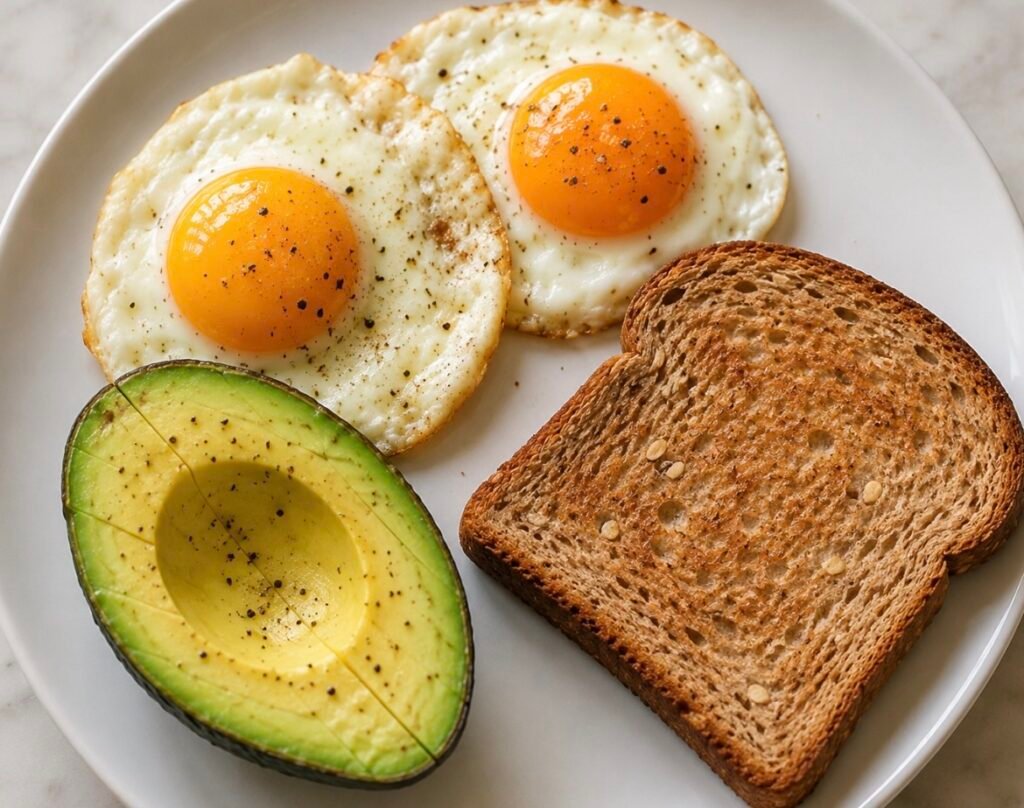
Eggs are almost pure protein and fat with next to no carbohydrate on their own, and a 2010 crossover study found an egg breakfast, compared to a calorie-matched bagel, led to a better glucose and appetite-hormone response and less eating later in the day. Avocado adds fiber and monounsaturated fat on top of that, and a few small randomized trials found adding avocado to breakfast lowered the glucose and insulin response compared to a matched meal without it.
The toast is optional, and swapping it for sautéed spinach or a side of berries works just as well if bread isn’t your thing. What matters is that the eggs and avocado are doing the heavy lifting either way.
I keep a jar of chia seeds next to the avocados specifically for mornings when I want to stir a spoonful into the eggs themselves or sprinkle it over the avocado half. It adds a second layer of fiber without changing how the plate tastes.
2. Greek Yogurt With Chia Seeds and Berries
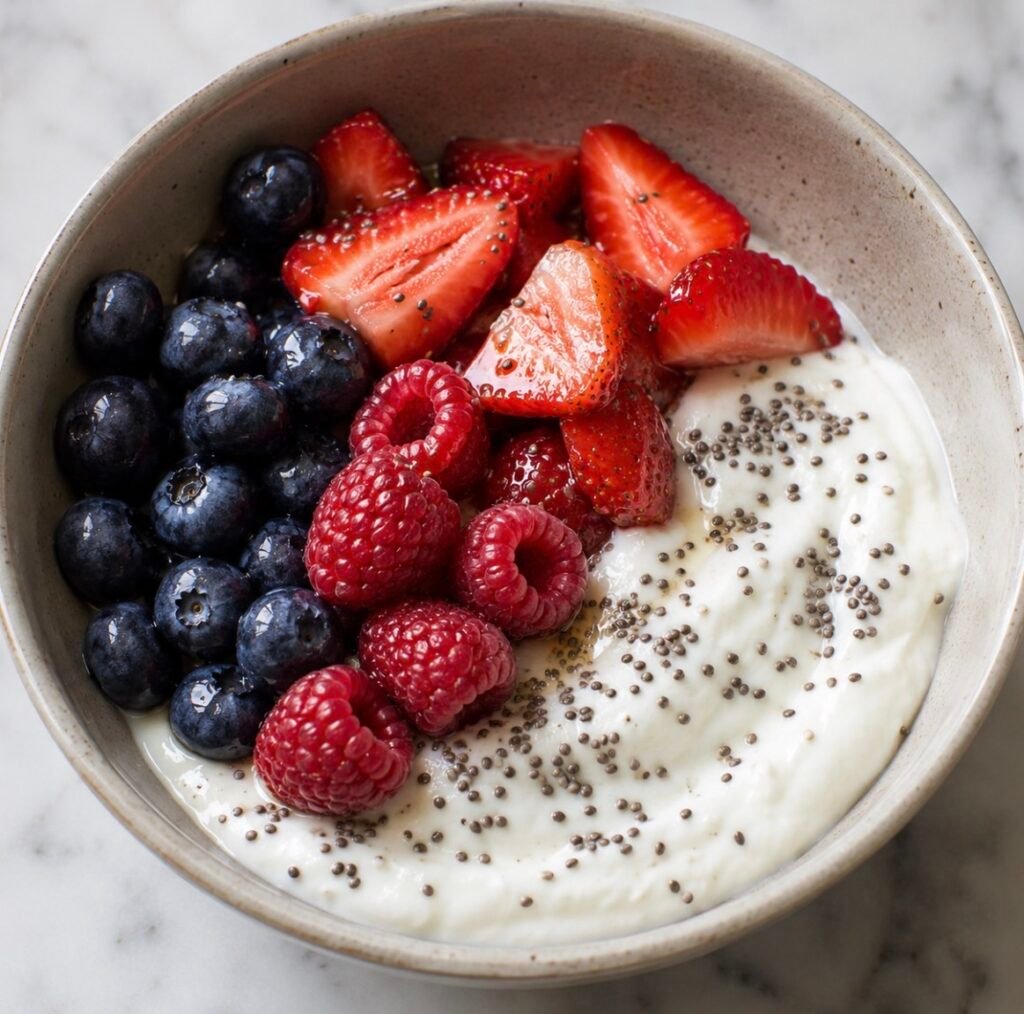
Greek yogurt‘s protein is concentrated enough that it digests slowly on its own, and pairing it with chia seeds adds soluble fiber that forms a gel in your gut and physically slows how fast sugar gets absorbed. This exact bowl, plain Greek yogurt with berries, flaxseed, and chia, is the one I come back to most on the mornings when I paid closer attention to how I felt two hours later.
Berries bring fiber and polyphenols without the sugar load of a banana or grapes, which matters since this bowl is doing the same job as a smoothie, minus the part where blending destroys the fruit’s fiber structure. A cup of yogurt, a tablespoon of chia seeds, and a handful of berries is the whole recipe, no scale required.
Stir the chia in and let the bowl sit for ten or fifteen minutes before eating, or mix it the night before. Chia only forms its gel once it hits liquid, so giving it that time is what gets you the slower-digesting effect, rather than eating it the second you stir it in. If you’re short on that wait, microwaving chia pudding speeds the same gelling process up to a few minutes instead of overnight.
Skip flavored or “light” yogurt for this one. Removing the fat from yogurt almost always means sugar gets added back in to make up the taste, sometimes 20 grams or more per cup, which defeats the entire point of the combo.
3. Cottage Cheese, Ground Flaxseed, Berries, and Cinnamon
Cottage cheese’s protein is mostly casein, which is well established in dairy science to digest slowly since it clots slightly in the stomach rather than passing through quickly. Ground flaxseed adds soluble fiber and plant omega-3s on top of that, and cinnamon has some evidence for a modest insulin-sensitizing effect, though that evidence is weaker and more mixed than the fiber and protein mechanisms doing the real work here.
This is the combo I reach for on mornings when I want something I can throw together in under a minute. Half a cup of cottage cheese, a spoonful of ground flaxseed, a handful of berries, and a shake of cinnamon on top.
Cottage cheese’s glycemic impact gets cited anywhere from very low to moderate depending on the source, so I won’t pretend there’s one settled number. What’s consistent across every source is that the protein content is what matters here, not a specific index figure.
4. Oats Fixed With Nut Butter, Yogurt, or Both

Plain oats eaten alone are the single most common “healthy breakfast” mistake in this entire list. Oatmeal by itself can spike blood sugar more than people expect, which is exactly what happened to me before I started pairing it with protein and berries instead of eating it plain.
The fix is a scoop of nut butter, a spoonful of Greek yogurt, or both, stirred into the oats along with chia or flaxseed. A small 2019 controlled study in the Journal of the American College of Nutrition found adding peanut butter to a high-glycemic meal cut the glucose spike almost in half compared to the same meal without it, 35.8 versus 51.0 mg/dL.
Half a cup of dry oats, a spoonful of natural peanut butter with no added sugar, and a spoonful of chia or flaxseed is the whole formula. Instant oat packets are the version most likely to disappoint here, since many flavored ones already have sugar mixed in before you add anything.
5. Baked Veggie and Egg Muffins, Made Ahead
This is the most genuinely grab-and-go of the six, and it’s one of the American Diabetes Association’s own recommended quick breakfasts through its consumer arm, Diabetes Food Hub. Eggs baked with spinach, peppers, and a little cheese in a muffin tin come out low in carbohydrate almost by definition, with whatever vegetables you used adding fiber on top.
I bake a batch on Sunday using whatever vegetables are about to go bad in my crisper drawer, and they reheat fine all week. A silicone muffin pan makes popping them out in one piece far less annoying than fighting a metal tin.
There’s no exact number of hours this one holds you, since no study measured this specific format directly, but the low overall carbohydrate load makes it a reasonable bet for the longer end of the range.
6. Nut or Seed Butter With Apple Slices or Toast
This combo has the strongest single controlled study behind it on this whole list, the same 2019 peanut butter research above, but I’ll be straightforward that it’s also the one least likely to hold you all the way to lunch. An apple’s natural sugar digests faster than the protein in eggs or dairy, so this one is closer to two or three hours of steady energy rather than four or five.
It’s still worth having on the list because it’s the fastest of the six to put together with zero prep. A spoonful of natural peanut butter on apple slices or a slice of toast, nothing measured, nothing cooked.
If you know a meeting is going to run past lunch, this is the one to pair with a handful of nuts on the side rather than eating it alone.
The Two Breakfasts Most Likely to Backfire
Fruit smoothies are the biggest one. Blending mechanically breaks down fruit’s fiber structure, so even an all-fruit “healthy” smoothie digests closer to a sugary drink than to eating the same fruit whole. Endocrinologist Dr. Jennifer Cheng has made a similar point about orange juice specifically, since juicing removes the fiber that would otherwise slow sugar absorption, and it’s easy to pour well past a single serving.
Instant oatmeal packets and “healthy”-marketed cereal are the second trap, since a health claim on the box doesn’t guarantee low sugar or slow digestion. I’ve learned not to treat any single rule about food as universal, and that caution applies here too. Read the label for grams of added sugar specifically, not the front-of-box claim.
Why “Until Lunch” Is a Realistic Target, Not a Guarantee
This is worth being honest about. The ADA’s Diabetes Food Hub states plainly that breakfast should include enough fiber and protein to keep you full “until lunchtime,” and that framing is real and attributable. Most of the research behind it tests windows of roughly four to five hours, not a universal guarantee for every body.
Eating protein and fiber before carbohydrate, often called food order, has gotten a lot of attention on social media lately, and the underlying science is real: a 2015 Weill Cornell study led by Dr. Louis Aronne found eating vegetables and protein before bread and juice lowered glucose by roughly 29 percent at 30 minutes and 37 percent at 60 minutes, tapering to about 17 percent by two hours out.
That said, a science communicator at McGill University has pointed out that the underlying research predates the current wave of popular framing by years, which is worth knowing before treating any single figure as a universal rule for your own body.
There’s also a real “second-meal phenomenon,” first described by researchers at Newcastle University in 2009, where a good breakfast measurably blunts your body’s glucose response to lunch too, not just the hours in between. It’s one more reason breakfast composition matters more than most people give it credit for.
Continuous glucose monitors have gone mainstream for non-diabetics since Dexcom’s Stelo and Abbott’s Lingo both got FDA clearance for over-the-counter sale in 2024, and that’s part of why blood sugar is such a hot search topic now. Worth knowing before you buy one: endocrinologists Dr. Minisha Sood and Dr. Farah Khan have both said on record that healthy people without diabetes generally don’t get real clinical value from wearing one. You can get most of the same benefit by just structuring breakfast this way, no sensor required.
FAQ
Do I need a food scale or app to eat this way?
No. Every combination above is a handful, a scoop, or a spoonful, the same portion cues the American Diabetes Association uses in its own plate method. None of it requires weighing or logging anything.
Why do plain oatmeal and smoothies spike blood sugar if they’re considered healthy?
Both are fast-digesting carbohydrate with nothing slowing them down when eaten alone. Blending fruit breaks down its natural fiber structure, and oats without added protein or fat digest quickly, especially instant oat packets.
How long will one of these combinations keep me full?
Roughly four to five hours for most of the protein-and-dairy-based combos, based on typical study windows, and closer to two to three hours for the nut butter and apple combo specifically. It varies by person, portion, and activity level.
Is it safe to eat chia seeds dry?
Stir them into something moist, like yogurt or oats, rather than eating a dry spoonful on its own. The American College of Gastroenterology has documented cases of dry chia swelling in the esophagus when someone eats it dry and chases it with water before it’s had a chance to hydrate, so give it a few minutes in liquid first.
Do I need a continuous glucose monitor to know if this is working for me?
No. Two named endocrinologists have said on record that healthy people without diabetes generally don’t get meaningful clinical value from one. Paying attention to how you feel two to three hours after eating is a reasonable substitute for most people.
Which combination should I start with if I’ve never eaten this way before?
Eggs with avocado or Greek yogurt with chia and berries. Both are the most forgiving, require the least specialty shopping, and are the easiest to make in under five minutes.

Cynthia Odenu-Odenu is the founder of Cyanne Eats. A registered nurse with a passion for food, she brings the same attention to detail from her professional life into the kitchen. From chain restaurant rankings to grocery finds and easy recipes, Cynthia covers it all and helps everyday food lovers eat better and spend smarter.