
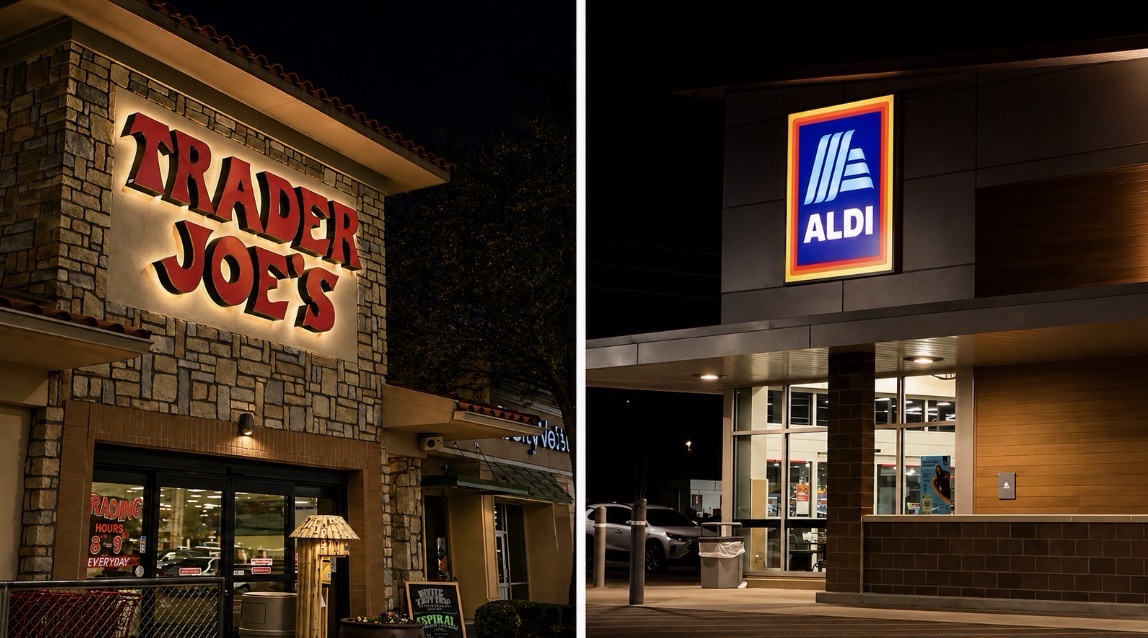
Aldi is cheaper than Trader Joe’s on nearly every staple grocery item, while Trader Joe’s has better frozen meals, cult snacks, and wine, and the most honest answer is that serious shoppers use both.
I want to get this comparison right because most takes on it are either lazy or misleading. These are not the same type of store. Aldi is a discount grocery store built to replace your weekly supermarket run.
Trader Joe’s is closer to a specialty food store with a rotating product lineup that keeps people coming back out of curiosity as much as necessity. Saying one is “better” without context is like saying a Honda Civic is better than a Harley-Davidson. They do different jobs.
That said, I have strong opinions about which one delivers more value for different types of shoppers, and I will give you those opinions directly.
One thing most people do not know: both chains are owned by branches of the same German family. Aldi is run by the Aldi Süd side of the Albrecht family. Trader Joe’s was acquired by the Aldi Nord side in 1979. They operate as completely separate companies with different supply chains, but they share DNA.
Table of Contents
Key Takeaways
- Aldi is 15 to 35% cheaper than Trader Joe’s on staple items including dairy, meat, produce, and pantry basics
- Trader Joe’s frozen foods are unmatched at any major chain. Mandarin Orange Chicken, Cauliflower Gnocchi, Butter Chicken, and Soup Dumplings have no real equivalents at Aldi
- Aldi has roughly 1,400 products; Trader Joe’s carries around 4,000, with about 80% of those being private label
- The biggest Aldi complaint is produce that spoils faster than expected; the biggest Trader Joe’s complaint is discontinuing beloved products with no warning
- The best grocery strategy in 2026 is shopping both: Aldi for the weekly staples haul, Trader Joe’s every other week for frozen meals, wine, and specialty snacks
Price: Aldi Wins and It Is Not Close
For identical or comparable items, Aldi is cheaper than Trader Joe’s on roughly 80% of overlapping products. The gap ranges from about 15% on basics like milk and bread to 35% or more on meat, produce, and organic items.
A realistic weekly basket comparison at both stores puts Aldi about 16% lower in the Midwest and closer to 25% lower in higher-cost markets. Aldi is cheaper than Walmart on a full grocery basket. That number is remarkable and it is the foundation of everything else about this comparison.
The reason Aldi can price this way is structural. They carry about 1,400 products compared to a traditional supermarket’s 30,000. More than 90% of what they sell is private label. They do not bag your groceries. You rent the cart for a quarter. The stores are small and staffed lean. Every one of those decisions eliminates overhead, and the savings get passed to you.
Trader Joe’s wins on a narrow list of items: certain olive oils, flowers, some wines, and a few nuts are cheaper there than Aldi. That list is real but it is short.
Frozen Foods: Trader Joe’s Wins and It Is Not Close
This is where Trader Joe’s has its real moat and the reason I still go there on a regular basis.
No other mainstream grocer in the country has a frozen food section like Trader Joe’s. The Mandarin Orange Chicken has been their bestseller for years and it deserves every bit of that reputation.
The sauce is genuinely good and the chicken crisps in the oven the way takeout never quite does. The Soup Dumplings (their second-highest Customer Choice Award winner in 2025) are the kind of product where I cannot believe they cost what they cost.
The Cauliflower Gnocchi, Butter Chicken, Kimbap, Brazilian Cheese Bread, and Chocolate Croissants are all genuine destination purchases for me.
Aldi’s frozen food is reliable and cheap. Season’s Choice frozen sweet corn has a real following. The frozen pizzas from Mama Cozzi are better than their price suggests. But none of it competes with Trader Joe’s as a frozen food destination.
If someone told me they were moving and could only keep one grocery store, and they ate a lot of frozen meals, I would tell them to keep Trader Joe’s.
For a full breakdown of what is worth buying at Trader Joe’s specifically, the best Trader Joe’s frozen meals guide covers every category.
Snacks: Trader Joe’s Wins on Cult Appeal, Aldi Wins on Value
Both stores have legitimately excellent snacks. The difference is personality.
Trader Joe’s snack lineup has some of the most talked-about products in the grocery industry. The Everything But The Bagel Sesame Seasoning ($1.99 in-store) changed how people think about seasoning blends and has been copied by nearly every major grocery chain.
The Dark Chocolate Peanut Butter Cups are better than Reese’s in my opinion. The Scandinavian Swimmers are the only gummy candy I buy anymore. Joe-Joe’s are a Oreo that is actually better than Oreo. The Chili Onion Crunch is the kind of condiment that shows up in every recipe I make for six months and then disappears from the store forever.
If you want Trader Joe’s cult favorites at home without making the trip, a few are available on Amazon via third-party sellers. The Everything But The Bagel Seasoning and 21 Seasoning Salute are both available, though I should note these are third-party resellers pricing them at roughly three to four times what they cost in-store. Worth knowing before you click.
Also in stock: Trader Joe’s Chili Onion Crunch, which disappears from shelves constantly but is easier to find on Amazon.
Aldi’s snack game is underrated. Clancy’s potato chips have beaten Lay’s in blind taste tests. Benton’s Speculoos cookies are a Biscoff dupe that I genuinely prefer. Moser Roth chocolate truffles are excellent. The Specially Selected premium line punches significantly above its price point.
For a full guide to what is worth buying, the best Aldi snacks guide has all of it.
For Trader Joe’s snacks specifically, the best Trader Joe’s snacks guide covers every category in depth.
Produce: Aldi Wins on Price, Trader Joe’s Wins on Quality
This is the category where I give the most honest advice: do not buy produce from Aldi if freshness matters to you.
This is the single most common complaint I hear about Aldi and it is legitimate. Berries that are moldy in 48 hours, herbs that wilt before you get home, pineapples that are already turning brown in the bin. The cause is structural. Aldi’s just-in-time supply chain prioritizes price over freshness, produce sits near the store entrance where temperature fluctuates, and the inventory turns over in ways that do not always favor freshness.
Trader Joe’s produce is fresher but comes with its own frustration: nearly everything is pre-packaged in plastic, and you often cannot buy a single piece of fruit. You get a bag of avocados when you wanted one.
My personal rule is to buy produce at Trader Joe’s and everything else at Aldi. That split gets you the best of both stores.
Dairy and Meat: Aldi Wins on Price, Both Are Solid on Quality
Aldi’s Friendly Farms milk, Happy Farms cheese, and Kirkwood chicken are all significantly cheaper than Trader Joe’s equivalents and comparable in quality for everyday cooking. The price gap on ground beef, whole chicken, and pork runs 20 to 25% in Aldi’s favor.
The one dairy exception is Trader Joe’s Unexpected Cheddar ($3.99 for 7 oz), a white cheddar with a sharp, almost parmesan-like crystalline texture that has no Aldi equivalent. I buy it regularly and it is worth the trip by itself.
Aldi’s Appleton Farms bacon gets mixed reviews. I have had batches that were great and batches that were mostly fat and not worth eating. It is inconsistent in a way that the other meat products are not.
Wine: Trader Joe’s Under $20, Aldi Under $5
Both stores sell cheap wine. The question is what you want from it.
Aldi’s Winking Owl line runs $3 to $5 a bottle. It is wine that exists. The Belletti Prosecco is a genuinely decent La Marca dupe. The California Heritage line at around $5 has shown up well in blind comparisons against Charles Shaw.
Trader Joe’s wine selection under $20 is one of the most consistently praised values in the wine world. The curation is real. They find Bandol rosé, Italian DOC reds, and interesting bottles from small producers at prices that should not be possible.
If wine matters to you, Trader Joe’s is where you spend that part of your budget.
The Shopping Experience: Very Different by Design
Trader Joe’s is designed to feel like a destination. Staff bag your groceries, samples are available at most locations, the product signs are hand-lettered by each store’s artist, and crew members wear Hawaiian shirts.
Checkout is slower but the experience is friendly and unhurried. Satisfaction ratings consistently put Trader Joe’s at or near the top of all grocery chains nationally.
Aldi is designed to be efficient. Checkout is about 40% faster than average. Staff are lean and productive. You bag your own groceries, you bring your own bags or buy a reusable one at the register, and you put a quarter in the cart slot to unlock it (you get it back when you return the cart). There are no samples. The store is organized for speed, not discovery.
One practical note on Aldi: if you are someone who forgets quarters, an Aldi quarter keychain holder that lives on your key ring solves this permanently. Small thing but it comes up every single time.
Neither experience is better in an absolute sense. They are optimized for different goals.
The Two Things That Frustrate Each Store’s Fans
Aldi’s biggest issue: The produce spoilage problem is real and ongoing. The second biggest is what some shoppers call shrinkflation. Packages that have gotten smaller while prices stayed flat, most noticeably on Benton’s Wafer Rolls and a few chip products.
Trader Joe’s biggest issue: Discontinuation. The Trader Joe’s subreddit is a near-permanent grief counseling session for products that vanished without explanation. In 2025 alone, popular products including Pancake Bread, Pretzel Breadsticks, and the beloved Chile Lime Chicken Burgers were discontinued. Trader Joe’s has no online store, no delivery, no app, and no loyalty program. If something disappears, you have no notice and no recourse. This is the trade-off for a product lineup that stays fresh and interesting.
Which Store Is Better for You
If you are feeding a family and grocery costs matter, shop Aldi. The savings on a real weekly grocery run are significant and the quality on pantry staples, dairy, and meat is genuinely competitive.
If you are a single person or couple who prioritizes flavor discovery, specialty frozen meals, and interesting snacks over total spend, Trader Joe’s delivers something no other chain does.
If you want organic options at reasonable prices, Aldi’s Simply Nature line beats Trader Joe’s on price across almost every organic category.
If you want wine under $20 that is worth drinking, Trader Joe’s. Under $5 that is drinkable, Aldi.
The majority of people who shop seriously at either store end up doing both: Aldi every week for the staples haul, Trader Joe’s every other week for the frozen section and the snacks. That combination covers your grocery needs better than either store does alone.
The Bottom Line
Aldi is the better grocery store if your goal is feeding your household efficiently at the lowest possible cost. Trader Joe’s is the better grocery store if your goal is finding interesting products, excellent frozen meals, and curated wine. Neither description is a criticism. They are just different tools for different jobs.
The honest answer in 2026 is that you do not have to choose. Aldi has over 2,500 locations across 39 states and is still expanding aggressively. Trader Joe’s has 631 locations and is growing more selectively. If both are near you, use both. The people who figure that out are the ones who spend less at checkout and eat more interesting food.
FAQ
Is Aldi cheaper than Trader Joe’s?
Yes. Aldi is cheaper than Trader Joe’s on roughly 80% of overlapping grocery items, with prices typically 15 to 35% lower on staples including dairy, meat, produce, and pantry goods. Aldi is cheaper than Walmart on a full grocery basket.
Which has better food quality, Aldi or Trader Joe’s?
Trader Joe’s has better quality frozen foods, specialty snacks, and wine. Aldi has comparable quality on dairy, meat, and pantry staples at significantly lower prices. Trader Joe’s produce is fresher and better packaged; Aldi’s produce is cheaper but spoils faster.
Are Aldi and Trader Joe’s owned by the same company?
They are both connected to the same German Albrecht family but are separate businesses. Aldi is owned by the Aldi Süd family branch. Trader Joe’s was acquired by the Aldi Nord branch in 1979 and is now run independently by the Theo Albrecht Jr. family foundation. They have separate supply chains and do not share products.
Does Trader Joe’s have delivery?
No. Trader Joe’s has no online store, no app, no delivery, and no curbside pickup as of 2026. Aldi offers curbside and Instacart delivery at most locations.
What does Aldi do better than Trader Joe’s?
Aldi consistently wins on price across staples, dairy, meat, and organic basics. The private label quality on pantry items is strong. The Specially Selected premium line is genuinely impressive for the price. The checkout process is significantly faster. Curbside and delivery are available. Aldi also has more than four times as many US locations.

Cynthia Odenu-Odenu is the founder of Cyanne Eats. A registered nurse with a passion for food, she brings the same attention to detail from her professional life into the kitchen. From chain restaurant rankings to grocery finds and easy recipes, Cynthia covers it all and helps everyday food lovers eat better and spend smarter.