
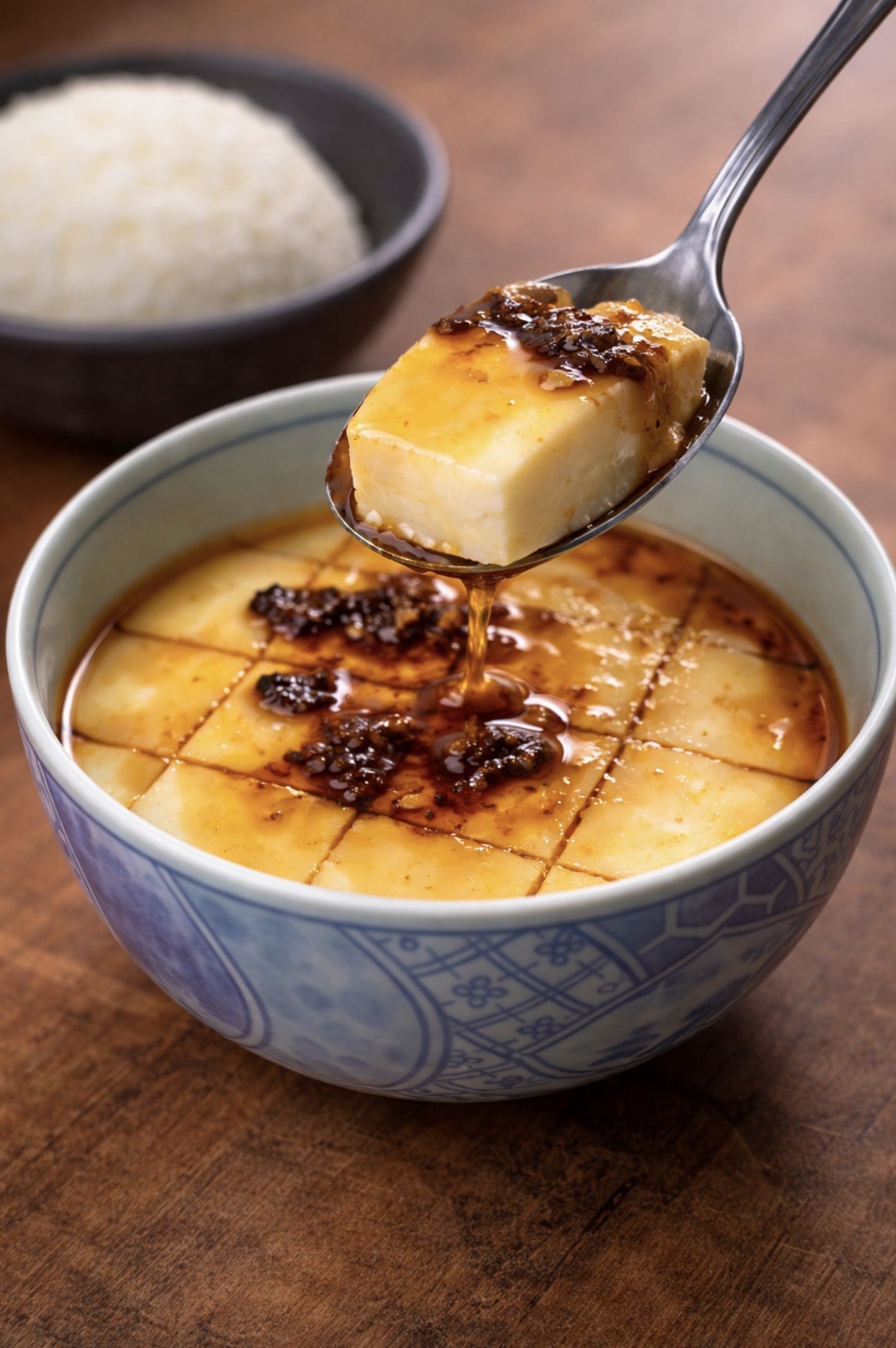
Chinese steamed egg is a savory custard made from beaten eggs diluted with warm water at a 1:2 ratio, strained to remove bubbles, and steamed on low heat until just set, then drizzled with soy sauce, sesame oil, and scallions.
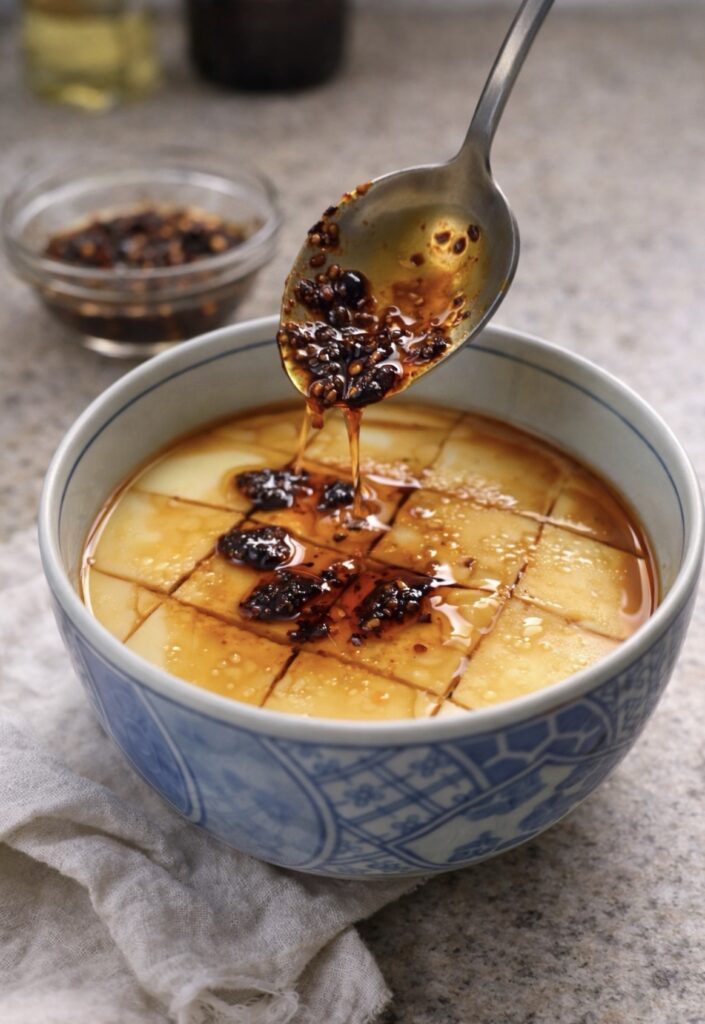
This recipe broke TikTok. When millions of Americans migrated to Chinese social media app Xiaohongshu during the TikTok ban in January 2025, Chinese steamed eggs became the dish that crossed the language barrier. A bilingual tutorial hit five million views in two days. Chinese users called it the recipe that made foreigners “practically family.”
I understand the appeal immediately. Three ingredients. Ten minutes. Something that looks and feels like a restaurant dish but requires no skill once you understand the ratio.
The ratio is everything. Get that right and the rest follows.
Table of Contents
Key Takeaways
- The ratio is 1 part egg to 2 parts liquid by volume. This is the single most important number in the recipe
- Use warm water, not cold and not hot. Hot water starts cooking the eggs before you steam them. Cold water causes uneven texture
- Always strain the mixture through a fine mesh sieve. This removes bubbles and lumps that cause the crater texture everyone wants to avoid
- Steam on low heat. High heat is what creates the honeycombed, rubbery texture
- Cover the bowl during steaming so condensation does not drip onto the surface
What Is Chinese Steamed Egg?
Called 蒸蛋 (zheng dan) in Mandarin and 蒸水蛋 (zheng shui dan) in Cantonese, this dish is China’s universal comfort food. It appears in lunchboxes, on hospital trays, at family tables, and in late-night kitchens. The texture is somewhere between very soft tofu and a barely-set custard. It wobbles when you tap the bowl.
It is also the ancestor of Japanese chawanmushi and Korean gyeran jjim. The same concept, different liquids and toppings.
The Chinese version is the simplest: water, eggs, salt. The liquid is what makes it distinctly Chinese rather than Japanese or Korean.
Why Does Mine Come Out Rubbery and Full of Holes?
This is the most common complaint and the reason most first attempts fail. Understanding why it happens fixes the problem before you start.
High heat is the cause of rubbery, honeycombed texture. Egg proteins contract quickly above about 85 degrees Celsius. When the steam around the custard is too hot, the proteins on the outside set hard and fast while the inside is still liquid. This squeezes out pockets of water and air, creating the crater or honeycomb look. Low heat allows the proteins to set gradually from edge to center, without trapping anything.
Dissolved gases in raw tap water cause internal micro-bubbles. These gases release during heating and get trapped inside the custard. The fix: use previously boiled water that has cooled, or mix boiling water with room temperature water. Both methods let gases escape before the water goes into the eggs.
Vigorous whisking adds air. Gentle stirring with chopsticks keeps the mixture bubble-free.
The Ratio: 1 Egg to 2 Parts Liquid
Everything else in this recipe is adjustable. The ratio is not.
Across sixteen independent sources from Chinese food writers, restaurant chefs, and home cooks, one part egg to two parts liquid by volume is the consensus for silky custard. Use less liquid and the custard is too firm. Use more and it will not set properly.
How to measure without a scale: Crack the eggs into your bowl. Pour the beaten eggs into one of the eggshell halves and count how many half-shells fill. For each half-shell of egg, you need two half-shells of warm water. This is how Chinese grandmothers measure it without a recipe.
With a scale: One large egg weighs about 50 grams. Use 100 grams of liquid per egg. Two eggs need 200 grams of liquid.
Water vs Broth: Which Is Better?
Plain water is the traditional approach. It produces a clean, pure egg flavor and is what most Chinese home cooks use. If you want to understand the dish, start here.
Chicken broth or bouillon is the most popular upgrade. Add one teaspoon of chicken bouillon powder dissolved in warm water or substitute warm low-sodium broth for all or half the water. The ratio stays the same. The result is noticeably richer.
Dashi crosses the dish into chawanmushi territory. It fundamentally changes the flavor profile from Chinese to Japanese. Not wrong, but a different dish.
Whatever liquid you choose, it should be warm, around 100 to 115 degrees Fahrenheit. The simplest method: mix equal parts boiling water and room temperature tap water. The result is approximately 50 degrees Celsius, exactly where you want it.
Ingredients You Need
Eggs, 2 large: Room temperature eggs blend more smoothly and produce a more even custard. Cold eggs from the fridge work fine but the texture can be slightly less uniform.
Warm water or chicken broth, about 3/4 cup: The exact amount depends on your eggs. Measure by volume after you beat the eggs and use exactly twice as much liquid.
Salt, 1/4 teaspoon: Or substitute a small pinch of chicken bouillon powder mixed into the liquid.
For topping:
- 2 teaspoons light soy sauce (Chinese-style light soy, not dark)
- 1 teaspoon toasted sesame oil
- 1 to 2 scallions, thinly sliced
- Optional: a few drops of chili oil or a pinch of white pepper
A Cuisinart fine mesh strainer set is the one tool that makes the biggest difference here. The smallest size in the set is exactly right for straining the egg mixture, and it doubles for tea, sauces, and dozens of other uses.
How to Make It
Step 1: Beat and measure
Crack the eggs into a bowl and beat gently with chopsticks or a fork until the yolks and whites are combined. Do not whisk vigorously. You want them blended, not frothy.
Pour the beaten eggs into a measuring cup and note the volume. You need exactly twice that amount of warm liquid. If you have 1/4 cup of beaten egg, you need 1/2 cup of warm water.
Add the salt to the warm liquid and stir to dissolve.
Step 2: Combine and strain
Pour the warm liquid into the eggs slowly while stirring gently. Pour in one direction only. The mixture should look smooth and pale yellow with no foam.
Set a fine mesh strainer over your steaming bowl. Pour the egg mixture through it. This removes the chalazae (the stringy white connective tissue), any unblended egg white, and all the surface bubbles. Strain it twice if you want to be thorough.
After straining, check the surface for bubbles. If any remain, skim them off with a spoon or dab them with a corner of a paper towel.
Step 3: Prepare the steamer
Fill your steamer pot or wok with water and bring it to a boil. A bamboo steamer, a wok with a rack, or any pot with a fitted lid all work.
Once boiling, reduce the heat to medium-low or low. This is the most important step. The steam temperature around the bowl needs to be gentle. High steam equals rubbery custard.
Step 4: Cover and steam
Cover the bowl with plastic wrap and poke 4 to 5 small holes in it with a toothpick. Alternatively, set a small plate directly on top of the bowl. Either cover prevents condensation from dripping onto the custard surface.
Place the bowl in the steamer. Steam for 10 to 12 minutes for a shallow bowl. The custard is done when the surface is set but still jiggles slightly in the center when you tap the side of the bowl. It should look pale yellow and smooth, not puffed or matte.
Remove from the steamer and let rest uncovered for 2 to 3 minutes. The residual heat will finish cooking the very center.
Step 5: Top and serve
Drizzle the soy sauce over the surface first, then the sesame oil. Scatter the sliced scallions. If you want to be generous, score a crosshatch pattern into the custard with a knife before adding the soy sauce so it seeps down into the custard rather than pooling on top.
Serve immediately with rice or on its own.
A lidded ceramic steaming bowl with its own fitted lid is the most elegant way to steam this. The lid does the work of the plastic wrap and goes straight from steamer to table.
The Woks of Life Method (Alternative Approach)
Some cooks prefer a hands-off version that uses residual heat instead of sustained low steaming.
Steam on high heat for exactly 3 minutes, then turn off the heat completely. Leave the lid on and do not open it for 14 minutes. The trapped steam finishes cooking the custard gently without any risk of overcooking.
This method works well if you are nervous about controlling the heat precisely. The result is slightly firmer than the low-and-slow approach but still smooth.
Chinese Steamed Egg vs Chawanmushi vs Gyeran Jjim
All three are egg custards steamed in a bowl. They are not the same dish.
Chinese steamed egg uses plain water or chicken broth, produces the silkiest flat custard texture, and is topped with soy sauce and sesame oil after cooking. It has no mix-ins in the base. It is the simplest of the three.
Japanese chawanmushi uses dashi (kombu and bonito broth) as the liquid, which gives it a distinctly umami-forward flavor. Ingredients like shrimp, chicken, mushrooms, and ginkgo nuts are hidden inside the custard. It is served in individual teacup-style vessels and is more refined and complex than the Chinese version.
Korean gyeran jjim intentionally incorporates air into the beaten eggs, producing a fluffy, soufflé-like result rather than a flat custard. It uses anchovy broth and is cooked in a bubbling clay pot. The texture is soft and pillowy rather than silky.
Troubleshooting
The surface is covered in holes and craters. The heat was too high. Reduce to medium-low or low before placing the bowl in the steamer.
The custard is rubbery and dense. Same cause: too much heat, or steamed too long. Check at 10 minutes and pull it as soon as the surface is set with a slight jiggle in the center.
There are bubbles all over the surface. The mixture was not strained, or surface bubbles were not skimmed before steaming. Always strain and skim.
The custard is watery and not setting. Too much liquid, or the heat was too low. Check your ratio and confirm the steamer is producing consistent steam.
The surface is smooth but there are holes inside. Raw tap water contains dissolved gases that release during steaming. Use water that has been boiled and cooled, or let the mixed egg mixture rest for 5 minutes before steaming.
The edges are set but the center is completely liquid. Not steamed long enough, or the bowl is too deep. Add 2 to 3 minutes and check again.
Tips for the Best Result
Rest the egg mixture for 5 minutes before steaming. Any remaining surface bubbles will rise to the top and are easier to skim off.
Use a shallow bowl. Shallower means more even heat distribution and shorter cooking time. A bowl about 6 to 8 inches wide and 2 inches deep is ideal.
Do not lift the lid to check. Opening the steamer releases steam and causes the temperature to drop suddenly, which can make the custard sink or develop an uneven surface. Wait the full 10 minutes before checking.
The topping matters. Light soy sauce (生抽) is specifically what you want here, not dark soy sauce or all-purpose soy. Chinese-style light soy sauce has a brighter, saltier, thinner flavor that complements the delicate custard without overpowering it.
Variations Worth Trying
With shrimp: Peel and devein small shrimp, season with salt and white pepper, and place them on top of the custard at the 7-minute mark of steaming. Steam for 2 to 3 more minutes until the shrimp are pink. The combination is one of the most popular restaurant versions.
With pork mince: Steam the plain custard fully. While it steams, cook a small amount of ground pork with ginger, soy sauce, and a pinch of sugar until cooked through. Spoon the pork sauce over the finished custard instead of plain soy sauce.
With chicken broth: Replace all the warm water with warm low-sodium chicken broth at the same 1:2 ratio. The result is noticeably more savory and rich with very little extra effort.
With ramen broth: If you make my Carbonara Buldak Ramen, save the leftover broth from the pot and use it as the liquid here. The creamy, spicy broth produces a completely different and very good version of the dish. This is one of the more interesting TikTok adaptations circulating right now.
Microwave method: Beat and strain the eggs as above. Cover the bowl tightly with plastic wrap. Microwave at 30 percent power in 2-minute intervals, checking after each, until just set. Less reliable than steaming but works in a pinch. Ms. Shi and Mr. He have a detailed method for this approach.
Serving Suggestions
Chinese steamed egg is almost always served with steamed white rice. The egg custard is meant to be eaten with the rice, using the soy sauce drizzle as a combined sauce for both.
It also works alongside stir-fried vegetables or as part of a larger family meal with multiple dishes. It is naturally light and pairs well with anything heavier.
For more recipes on the viral TikTok end of the Chinese food spectrum, this recipe is part of my Viral TikTok Recipes roundup.
Storage and Reheating
This dish is best eaten immediately. The texture degrades with storage and does not freeze well.
If you have leftovers, refrigerate in an airtight container for up to 2 days. To reheat, re-steam for 3 to 4 minutes over medium-low heat. Microwaving on the lowest power setting for 30-second intervals also works, but the texture will be slightly less silky. Do not microwave on full power.
Do not freeze. The custard separates and turns grainy when thawed.
Conclusion
Chinese steamed egg is a ratio problem. Every failed version comes down to the same two variables: too much heat or the wrong ratio. Use warm liquid at 1:2, steam on low heat, strain before it goes in the bowl, and cover it during steaming. The result is one of the most satisfying things you can make in ten minutes with ingredients that cost almost nothing.
FAQ
What is the correct egg-to-water ratio for Chinese steamed egg?
1 part beaten egg to 2 parts warm liquid by volume. This is the consensus across the vast majority of Chinese food sources and produces the classic silky texture. More water than that and it will not set. Less water and it will be too firm.
Why is my steamed egg full of holes?
The most common cause is steaming on too-high heat. Reduce the heat to medium-low or low before placing the bowl in the steamer. Also strain the mixture and skim surface bubbles before steaming, and cover the bowl to prevent condensation from dripping.
Can I use cold water?
Use warm water. Cold water does not emulsify as smoothly with the beaten eggs and leads to uneven texture. Mix equal parts boiling water and room temperature tap water for an easy approximation of 50 degrees Celsius.
Do I have to strain the egg mixture?
Yes. Straining removes the chalazae, air bubbles, and unblended egg white. These cause an uneven, bumpy custard surface. A fine mesh strainer takes about 10 seconds and makes a visible difference in the finished texture.
Can I use broth instead of water?
Yes. Chicken broth at the same 1:2 ratio produces a noticeably richer result. Low-sodium broth works best so you can control the saltiness. Reduce or skip the added salt if the broth is already seasoned.
How do I know when it is done?
The surface should be pale yellow and set, with a slight jiggle in the center when you tap the side of the bowl. If the center is completely liquid, steam another 2 to 3 minutes. If the surface is puffed and matte, it was overcooked.
Can I make this without a steamer?
Yes. Any pot with a lid and a rack works. Set a small rack or upturned bowl in a pot with an inch of water, place your bowl on the rack, cover, and steam on low heat. A wok with a lid and a wok rack is the traditional setup.
What kind of soy sauce should I use?
Chinese-style light soy sauce (生抽). This is thinner, saltier, and lighter in color than dark soy sauce. It adds the right umami without darkening or overpowering the custard. Kikkoman also works, but a Chinese light soy is closer to the traditional taste.
Chinese Steamed Egg (蒸蛋)
Ingredients
- 2 large eggs, room temperature
- Warm water (exactly 2x the volume of beaten eggs, approximately 3/4 cup)
- 1/2 tsp salt
- 2 tsp light soy sauce, for topping
- tsp tsp toasted sesame oil, for topping
- 2 scallions, thinly sliced
- Optional: pinch of white pepper in the egg mixture, chili oil for topping
Instructions
- Beat eggs gently with chopsticks until combined. Do not whisk vigorously.
- Measure beaten eggs by volume. Warm exactly twice as much water to 100 to 115 degrees Fahrenheit (mix equal parts boiling and room-temperature water). Add salt to water and stir to dissolve.
- Pour warm water into eggs slowly, stirring gently in one direction. Strain through a fine mesh sieve into your steaming bowl. Skim any surface bubbles.
- Cover bowl with plastic wrap poked with a few holes, or rest a plate on top.
- Bring steamer water to a boil, then reduce heat to medium-low. Place bowl in steamer and steam 10 to 12 minutes until surface is set with a slight jiggle in the center.
- Remove from steamer and rest 2 to 3 minutes. Drizzle with soy sauce and sesame oil, scatter scallions, and serve immediately with steamed rice.
Notes

Cynthia Odenu-Odenu is the founder of Cyanne Eats. A registered nurse with a passion for food, she brings the same attention to detail from her professional life into the kitchen. From chain restaurant rankings to grocery finds and easy recipes, Cynthia covers it all and helps everyday food lovers eat better and spend smarter.