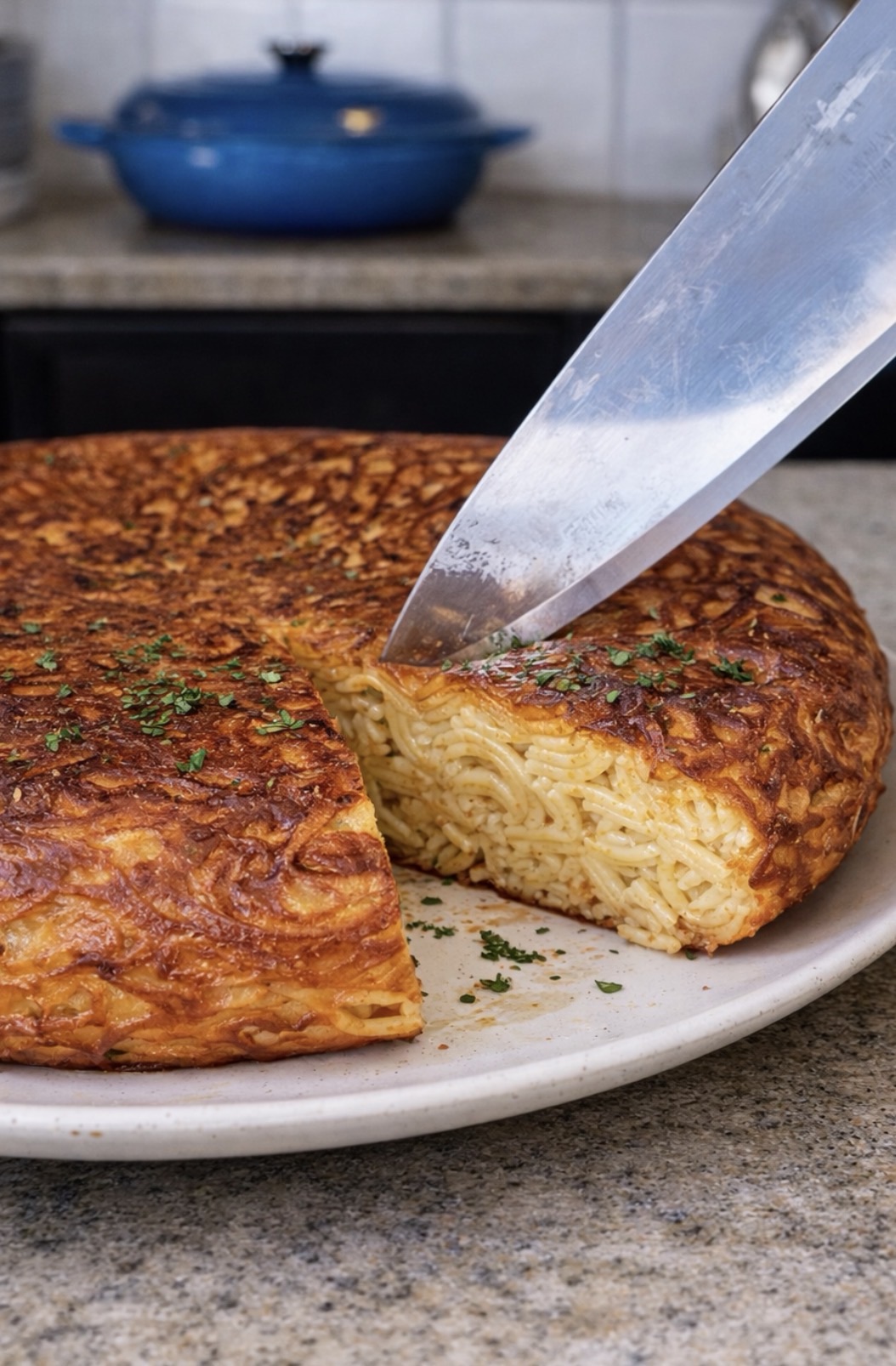
A leftover spaghetti frittata is a pan-fried Italian egg dish where cold cooked spaghetti is bound with beaten eggs and cheese, cooked in a skillet until golden and crispy on the outside, then sliced into wedges like a pie.
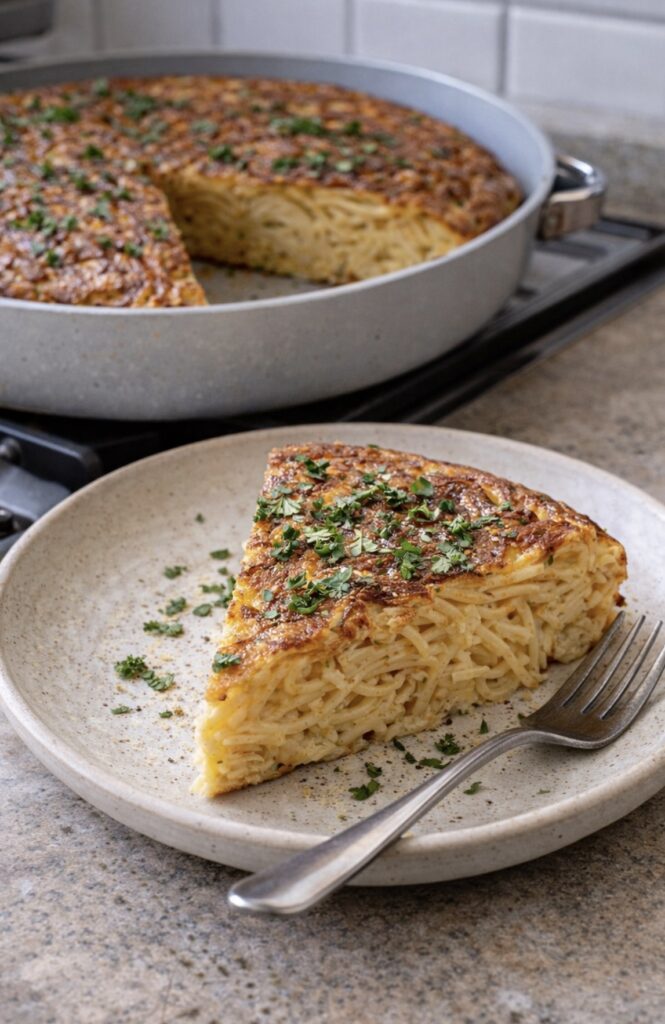
I used to throw away leftover spaghetti without thinking twice. Then I found out that Neapolitans have been transforming Sunday pasta into Monday’s best meal for at least two hundred years, and I felt appropriately embarrassed.
This is one of those recipes where the result looks far more impressive than the effort involved. You beat a few eggs, mix them with cold spaghetti and cheese, pour it into a hot pan, and twenty minutes later you have something that looks like it came from a trattoria. The crispy edges are the best part.
Table of Contents
Key Takeaways
- Use 1.5 to 2 eggs per cup of cooked pasta. The pasta should dominate; the eggs just bind everything together
- Cold pasta straight from the fridge works fine. Toss it with a drizzle of olive oil first to loosen the strands
- The stovetop method gives you crispy edges on both sides but requires a flip. The broiler method gives you a golden top with no flip needed
- Do not overcook. The interior should be soft and chewy, not dry
- This dish is excellent at room temperature, which is why Neapolitans have been eating it at the beach for generations
What Is a Spaghetti Frittata?
Frittata di spaghetti is a dish from Naples, where it is known as frittata ‘e maccarune in the local dialect. The concept is simple: leftover cooked pasta bound with eggs and cheese, pan-fried until golden on both sides. Neapolitans invented it as a way to use Sunday’s ragù pasta the next morning, and it became so beloved that many Italian families now cook extra pasta on purpose just to make it.
The dish is quintessentially portable. In Naples it is cut into wedges, wrapped in paper, and taken to picnics and beach trips to the islands of Ischia and Procida. It appears at Easter Monday gatherings, packed lunches, and late-night snacks. It tastes just as good cold as it does hot, which makes it one of the most practical things you can cook.
Spaghetti Frittata vs. Spaghetti Pie: What Is the Difference?
These two dishes share a name in some Italian-American households but they are completely different recipes. Spaghetti frittata is pan-fried and Italian. It uses eggs as a light binder, cooks in 20 minutes, and is portable. Spaghetti pie is an American comfort food that is baked in the oven, layered with ricotta, meat sauce, and melted cheese, and takes 45 to 60 minutes. One is essentially an elegant egg dish; the other is a round lasagna.
My Leftover Spaghetti Pie Recipe covers that heartier baked version if that is what you are after.
Ingredients You Need
Cooked spaghetti, about 3 to 4 cups (roughly 12 oz): Cold leftover spaghetti is ideal. Toss it with a teaspoon of olive oil before mixing to separate any clumped strands. If you are cooking pasta fresh for this recipe, pull it one minute before al dente since it continues cooking in the pan.
Eggs, 5 to 6 large: The ratio that matters is about 1.5 to 2 eggs per cup of cooked pasta. Too many eggs and you get a pasta-flavored frittata. Too few and it falls apart. The pasta should clearly be the star.
Parmigiano-Reggiano or Grana Padano, 1/3 cup freshly grated: This is the flavor backbone of the dish. Pre-grated parmesan from a container has anti-caking powder added and does not melt the same way. Grate it yourself if you can.
Scamorza or provolone, 2 to 3 oz diced small: This is the traditional Neapolitan melting cheese that creates pockets of gooey texture throughout the frittata. Scamorza is the authentic choice, but provolone is widely available and works beautifully. Low-moisture mozzarella also works.
Olive oil, 3 tablespoons: For cooking. Do not substitute butter for the stovetop method as it burns too easily at the heat needed for a good crust.
Salt and black pepper: Season the egg mixture well before adding the pasta. If your leftover pasta was already well-sauced and salted, taste first.
Fresh parsley, 2 tablespoons chopped (optional)
How to Make It: Two Methods
Method 1: Stovetop with Flip (Traditional)
This is the classic Neapolitan approach. It gives you crispy golden edges on both sides but requires committing to a flip.
Step 1: Mix the base
Beat the eggs in a large bowl. Add the grated parmesan, diced scamorza or provolone, parsley if using, salt, and pepper. Stir to combine. Add the pasta and fold everything together until the strands are evenly coated with egg.
Step 2: Start the cook
Heat 2 tablespoons of olive oil in a 10-inch nonstick skillet over medium-high heat. When the oil is hot but not smoking, add the pasta mixture and press it down firmly with a spatula into an even, compact disc. Cook undisturbed for 1 minute on high heat, then reduce to medium-low.
Step 3: First side
Cover the pan and cook for 7 to 8 minutes without stirring. Check by lifting one edge with a spatula. The bottom should be a deep golden brown and the frittata should slide as one piece when you shake the pan. If it sticks, give it another 2 minutes.
Step 4: The flip
Place a flat plate larger than your skillet directly on top of the pan. With one hand on the handle and your other palm pressing firmly on the plate, flip the pan in one confident, swift motion so the frittata lands on the plate cooked side up. Slide the remaining tablespoon of oil into the pan, then slide the frittata back in uncooked side down.
Step 5: Second side
Cook uncovered for 4 to 5 minutes until the second side is golden. Slide onto a cutting board or serving plate, rest for 2 minutes, then cut into wedges.
Method 2: Stovetop to Broiler (No Flip Needed)
This is the easier method and produces a slightly puffier, golden-topped frittata.
Step 1: Mix the base exactly as above.
Step 2: Heat 2 tablespoons of olive oil in an oven-safe skillet over medium heat. Add the pasta mixture, press into a disc, and cook for 6 to 8 minutes until the edges are set and the bottom is golden.
Step 3: Transfer the pan to the oven under a preheated broiler, 6 inches from the element. Broil for 3 to 4 minutes until the top is puffed and golden brown. Watch it the entire time. It goes from perfect to overdone quickly.
Step 4: Rest 2 minutes in the pan, then slide onto a cutting board and cut into wedges.
A Lodge 10.25-inch Cast Iron Skillet is the best vessel for the broiler method because it goes seamlessly from stovetop to oven and holds heat evenly. Grab the silicone handle holder when you pull it out. The Lodge Skillet with Handle Holder bundle gets you both at once.
Flip Tips: How to Not Ruin It
The flip is the part everyone worries about. Here is how to make it work.
Confirm it is ready before you flip. Run a thin spatula around the edges and under the frittata. It should release cleanly and move as a single unit when you shake the pan. If any part is still liquid or sticking, wait another 2 minutes.
Use a plate that is noticeably larger than the pan. A plate the same size as the skillet gives you no margin for error.
Commit. A slow or hesitant flip is what causes breaks. Get your grip firm on both the pan handle and the plate, then flip in one quick, confident motion.
Move the pan over the sink first. If something goes sideways, the cleanup is much easier.
If it breaks, it still tastes exactly the same. Press the pieces back together in the pan and continue cooking. Once it is plated and cut into wedges, nobody will know.
A flexible spatula helps enormously with loosening the edges and sliding wedges onto plates cleanly. The OXO Good Grips Large Silicone Turner is my go-to for this.
Tips for the Best Result
Season the eggs well. The pasta is already cooked and may be unsalted or very mildly seasoned. The egg mixture needs to carry a good amount of flavor on its own. Taste it before adding the pasta.
Use enough oil. Three tablespoons sounds like a lot. It is not. The oil is what creates the crust and prevents sticking. Going too light on oil is the most common reason frittatas stick.
Do not stir after you press it down. Resist the urge to push it around. Letting it sit undisturbed is what builds the crust.
Let it rest before cutting. Two minutes of resting lets the interior firm up just enough to cut into clean wedges.
Plain or sauced pasta both work. If your leftover spaghetti has meat sauce on it, the frittata will have a warm reddish-gold color inside. If it is plain buttered pasta, the frittata will be golden throughout. Both are good. Reduce the salt if your pasta was heavily sauced.
Variations Worth Trying
With pancetta or salami: Dice 2 oz of pancetta and cook it in the pan first, then use the rendered fat instead of olive oil and fold the crispy pieces into the egg mixture. This is the most popular Italian upgrade.
With lefover meat sauce: Use sauced spaghetti straight from the container. The tomato in the sauce adds depth and the frittata turns a beautiful amber-gold color inside.
Vegetable additions: Fold in a handful of sauteed zucchini, wilted spinach, or roasted cherry tomatoes cut in half. Add them to the egg mixture before folding in the pasta.
Carbonara frittata: Mix 2 oz diced guanciale or bacon into the egg mixture alongside the parmesan, and use the stovetop method. A Roman-inspired version of the dish.
What to Serve With It
A simple green salad is the classic Neapolitan pairing and it works perfectly. The acidity of a vinaigrette cuts through the richness of the eggs and cheese.
This recipe feeds directly into the leftover spaghetti cluster. If you want more ideas for what to do with leftover pasta, all of them are in my Easy Leftover Spaghetti Recipes roundup.
How to Store and Reheat
Store leftovers in an airtight container in the fridge for up to 3 days, counting from when the original pasta was cooked.
One of the best things about this dish is that it is excellent cold or at room temperature. That is the whole point of Neapolitan frittata as picnic food. If you want to reheat it, microwave individual slices for 45 to 60 seconds, or warm wedges in a 350 degree oven for 8 minutes.
The frittata also freezes well for up to one month. Wrap individual wedges tightly in plastic wrap, then place in a freezer bag. Thaw overnight in the fridge and reheat as above.
Conclusion
The spaghetti frittata is proof that the best leftover dish is often the simplest one. You need eggs, cheese, pasta, and a hot pan. The technique is straightforward once you understand what you are trying to achieve: a crispy outer crust that holds together a soft, chewy pasta interior. Season the eggs well, use enough oil, do not flip before the base is solid, and commit when you flip. That is the whole recipe.
If you have been throwing away leftover pasta, this is the reason to stop.
FAQ
Can I use any type of leftover pasta for this recipe?
Yes. Spaghetti and other long pasta shapes create the best structure and slice most cleanly. Short pasta like penne or rigatoni also works but makes a looser result that needs slightly more egg to hold together.
How many eggs do I need for one cup of leftover spaghetti?
About 1.5 to 2 eggs per cup of cooked pasta. For 3 to 4 cups of spaghetti, 5 to 6 eggs is the right range. Use more egg if you want a softer result, fewer if you want it denser and more pasta-forward.
Do I have to flip the frittata?
No. The stovetop-to-broiler method skips the flip entirely. Cook the frittata on the stovetop for 6 to 8 minutes until the base is set, then finish under the broiler for 3 to 4 minutes until the top is golden. It is the easier method with no risk of breakage.
My frittata stuck to the pan. What went wrong?
Either there was not enough oil, the pan was not hot enough before adding the pasta, or you tried to flip before the base had fully set. Use a well-seasoned nonstick pan or cast iron, do not skimp on the olive oil, and confirm the frittata releases cleanly from all sides before you flip.
Can I make this with plain unsauced pasta?
Yes. Plain pasta produces a golden, clean-flavored frittata. The cheese and egg carry all the flavor. Add a bit more salt to the egg mixture if the pasta has no seasoning on it.
Is spaghetti frittata the same as spaghetti pie?
They are related but different. Frittata is pan-fried and Italian, uses eggs as a light binder, and is done in 20 minutes. Spaghetti pie is baked in the oven, layered with ricotta and meat sauce, and takes much longer. One is a quick egg dish; the other is closer to a baked casserole.
Can I freeze leftover spaghetti frittata?
Yes. Wrap individual wedges in plastic wrap and store in a freezer bag for up to one month. Thaw overnight in the fridge and reheat in a 350 degree oven or microwave.
Easy Leftover Spaghetti Frittata
Ingredients
- 3 to 4 cups leftover cooked spaghetti (about 12 oz), tossed with 1 tsp olive oil
- 5 to 6 large eggs
- 1/3 cup freshly grated Parmigiano-Reggiano or Grana Padano
- 2 to 3 oz scamorza or provolone, diced small
- 3 tbsp olive oil, divided
- Salt and freshly ground black pepper to taste
- 2 tbsp chopped fresh parsley (optional)
Instructions
Stovetop Method
- Beat eggs in a large bowl. Add parmesan, diced cheese, parsley if using, salt, and pepper. Stir to combine. Fold in the pasta until evenly coated.
- Heat 2 tablespoons olive oil in a 10-inch nonstick skillet over medium-high heat. Add the pasta mixture and press into a compact disc. Cook 1 minute on high, then reduce to medium-low.
- Cover and cook 7 to 8 minutes until the bottom is golden and the frittata releases cleanly from the pan.
- Place a large plate over the pan. Flip the pan and plate together in one swift motion. Add remaining tablespoon of oil to the pan and slide the frittata back in, uncooked side down.
- Cook uncovered 4 to 5 minutes until the second side is golden. Rest 2 minutes, then cut into wedges.
Broiler method (no flip)
- Mix as above. Heat 2 tablespoons olive oil in an oven-safe skillet over medium heat. Add the pasta mixture and press into a disc. Cook 6 to 8 minutes until the edges are set and the bottom is golden.
- Transfer to the broiler, 6 inches from the element. Broil 3 to 4 minutes until the top is puffed and golden. Watch closely.
- Rest 2 minutes in the pan, then cut into wedges.
Notes
Sauced pasta: Leftovers with meat sauce or tomato sauce work well. Reduce added salt since the sauce already provides seasoning.
The flip: Confirm the frittata releases cleanly from all sides before flipping. Move the pan over the sink as a precaution.
Storage: Refrigerate up to 3 days. Excellent cold or at room temperature. Freezes for up to 1 month.

Cynthia Odenu-Odenu is the founder of Cyanne Eats. A registered nurse with a passion for food, she brings the same attention to detail from her professional life into the kitchen. From chain restaurant rankings to grocery finds and easy recipes, Cynthia covers it all and helps everyday food lovers eat better and spend smarter.