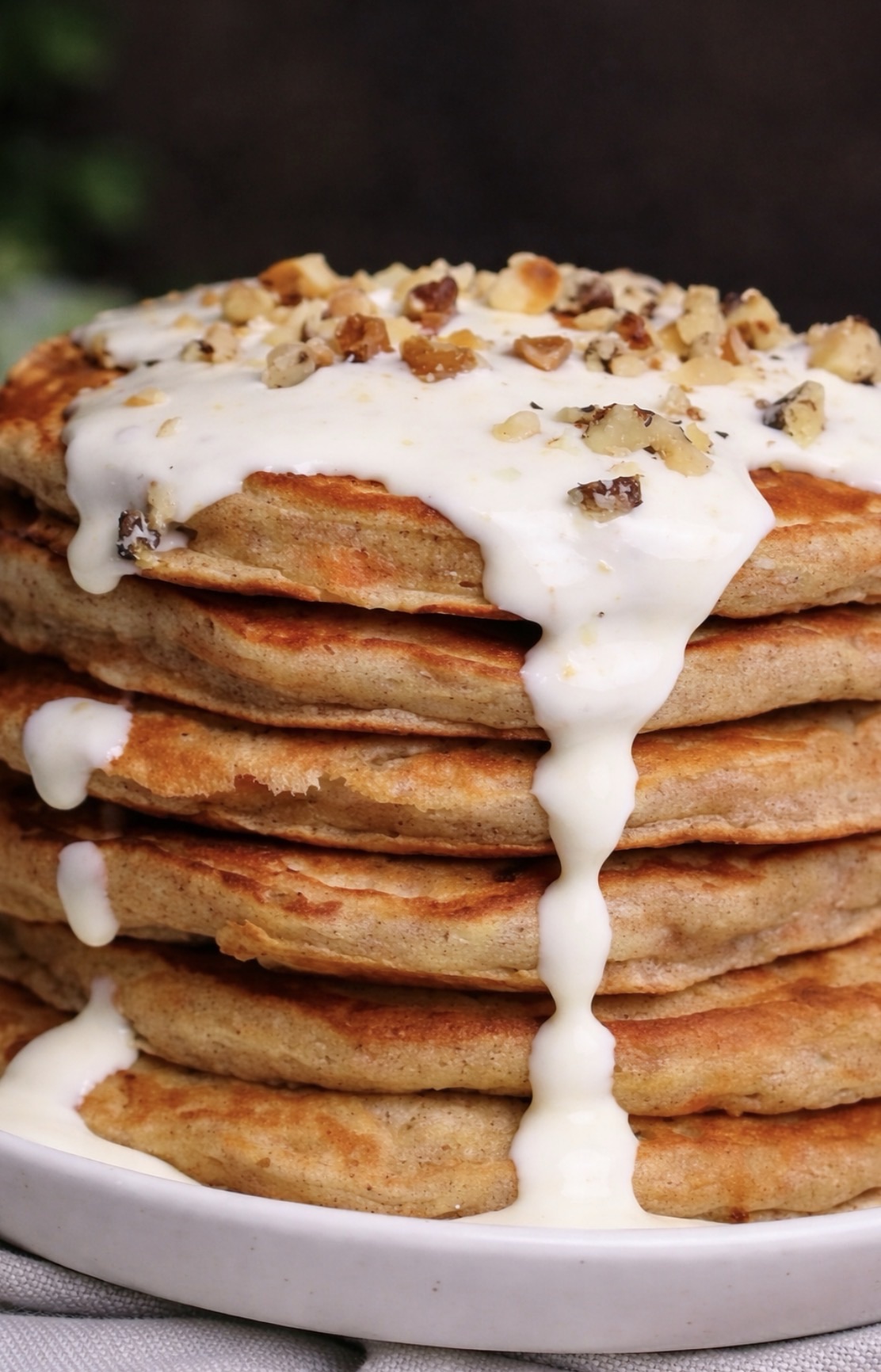
Carrot cake pancakes are warm-spiced buttermilk pancakes loaded with finely grated fresh carrots, topped with a whipped cream cheese butter that melts into the stack and mimics the cream cheese frosting that makes carrot cake worth eating.
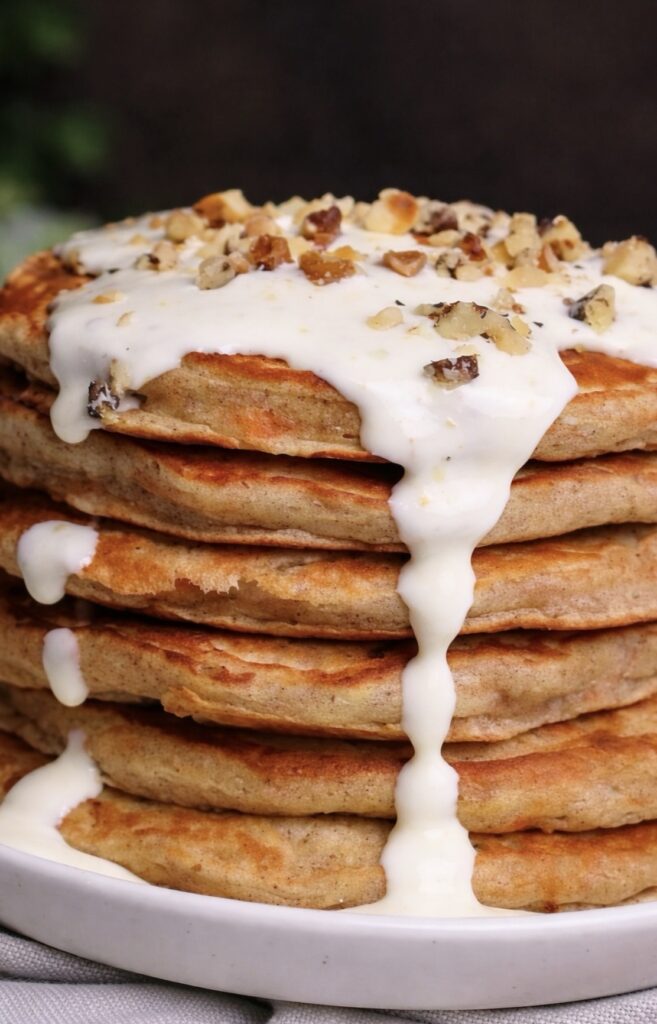
This is my go-to Mother’s Day brunch recipe. It looks impressive, takes about 30 minutes, and tastes like dessert for breakfast without actually being dessert. The stack comes out fluffy, lightly spiced, and studded with soft carrot pieces. The cream cheese butter melts on contact and pools between the layers in the best way possible.
Most recipes call for a cream cheese glaze or drizzle. I make a compound butter instead. The butter format melts cleaner, pools between pancakes, and does not need powdered sugar to thicken. It is less sweet and more functional, which is exactly what you want at the breakfast table.
Table of Contents
Key Takeaways
- Finely grate the carrots yourself from whole, fresh carrots. Pre-shredded bagged carrots are too coarse, too dry, and do not soften in the 4 to 5 minutes a pancake takes to cook
- Do not overmix the batter. Stir until just combined and let it rest 5 to 10 minutes before cooking. Overmixing develops gluten and produces tough, dense pancakes
- Cook on medium to medium-low heat. The temptation is to crank the heat. High heat browns the outside before the center sets
- The cream cheese butter needs to be at room temperature to whip properly. Cold cream cheese will not blend smooth
- Make the cream cheese butter first so it has time to come together while you cook the pancakes
Why Cream Cheese Butter, Not Frosting
Almost every carrot cake pancake recipe calls for a cream cheese glaze, drizzle, or frosting. Those are good. This is better.
A compound butter is cream cheese beaten together with softened butter until completely smooth, sweetened lightly with powdered sugar and vanilla. The result is thick, spreadable, and rich; not runny, not sticky, not cloyingly sweet.
When you drop a spoonful onto a hot stack, it melts slowly. The butter and cream cheese separate just slightly as they warm, creating a glossy sauce that pools between the layers and coats the edges. It behaves more like a finishing butter than a frosting, which means it plays well with maple syrup rather than competing with it.
It is also easier to make than a proper glaze. No thinning, no drizzling, no concern about it sliding off cold pancakes. You drop a spoonful on top and let the heat do the rest.
Ingredients
For the pancakes (makes 8 to 10):
All-purpose flour, 1 cup: Measured by spooning into the cup and leveling off. Packed flour produces dense pancakes.
Brown sugar, 2 tablespoons: Brown sugar over white for the molasses notes that push this toward carrot cake territory.
Baking powder, 1.5 teaspoons
Baking soda, 1/2 teaspoon: The baking soda reacts with the buttermilk acid and gives you lift. Both leaveners together are important.
Salt, 1/2 teaspoon
Cinnamon, 1 teaspoon: The dominant spice. Cinnamon is what tells your brain this is carrot cake.
Ground ginger, 1/4 teaspoon
Nutmeg, 1/4 teaspoon: Freshly grated from a whole nutmeg is noticeably better than pre-ground. A Microplane zester handles both the nutmeg and the carrots.
Buttermilk, 1 cup: Real buttermilk produces the best texture. If you do not have it, stir 1 tablespoon of white vinegar or lemon juice into 1 cup of regular milk and let it sit for 5 minutes.
Egg, 1 large: Room temperature.
Vanilla extract, 1 teaspoon: Pure vanilla only. Imitation vanilla is detectable in delicate batters.
Butter or neutral oil, 1 tablespoon, melted
Fresh carrots, 1 cup finely grated: About 2 medium carrots. Must be fresh, whole carrots grated yourself. This is approximately 4 oz of carrots before grating.
Optional add-ins: 1/4 cup chopped toasted pecans or walnuts, 1 teaspoon orange zest.
For the cream cheese butter:
Cream cheese, 4 oz, room temperature: The block kind, not whipped. Whipped cream cheese has too much air and too much moisture.
Unsalted butter, 2 tablespoons, room temperature
Powdered sugar, 1/2 cup: This amount keeps it buttery rather than sweet. Add up to 3/4 cup if you prefer a sweeter topping.
Vanilla extract, 1/2 teaspoon
Pinch of salt
For serving: Real maple syrup, toasted pecans, powdered sugar.
A bottle of pure Vermont maple syrup alongside the cream cheese butter takes this over the top. Grade A Amber Rich is the right grade for pancakes because it’s robust enough to hold up against the warm spices.
How to Make the Cream Cheese Butter
Make this first so it has time to sit at room temperature and soften further while you cook.
Beat the room-temperature cream cheese and butter together using a stand mixer or a sturdy fork until completely smooth with no lumps. A KitchenAid stand mixer fitted with the paddle attachment does this in about 90 seconds on medium speed, and the tilt-head design and 5-quart bowl mean both hands stay free the whole time.
Add the powdered sugar, vanilla, and salt. Beat again until fully combined and fluffy, about 1 minute. Taste and adjust. If it is too dense, add 1 teaspoon of milk and beat again.
Transfer to a small bowl and set aside at room temperature. Do not refrigerate it. Cold butter will seize up and not melt properly on the pancakes.
The cream cheese butter keeps in the fridge for up to 5 days. Bring it back to room temperature before serving.
How to Make the Pancakes
Step 1: Grate the carrots
Grate the carrots on the small holes of a box grater or use a food processor fitted with the grating disc. You want fine shreds, not coarse ribbons. Coarse shreds will not soften before the pancake is done.
After grating, spread the carrots on a paper towel and press firmly to remove excess moisture. Wet carrots make batter loose and produce flat pancakes.
For extra softness, which I recommend for Mother’s Day especially: spread the squeezed carrots on a plate, cover with a damp paper towel, and microwave for 90 seconds. Let them cool slightly before adding to the batter.
Step 2: Mix the dry ingredients
Whisk together the flour, brown sugar, baking powder, baking soda, salt, cinnamon, ginger, and nutmeg in a large bowl. Make a well in the center.
Step 3: Mix the wet ingredients
In a separate smaller bowl, whisk together the buttermilk, egg, melted butter, and vanilla until combined.
Step 4: Combine
Pour the wet ingredients into the dry and stir gently with a spatula or fork until just combined. The batter should still be lumpy. Do not try to smooth it out. Overmixing is the single most common reason carrot cake pancakes turn out dense.
Fold in the grated carrots and any add-ins. Stir once or twice, no more.
Let the batter rest for 5 to 10 minutes. The resting time lets the gluten relax and the leaveners start working. The batter will thicken slightly and may develop small bubbles on the surface.
Step 5: Cook
Heat a griddle or large nonstick skillet over medium heat. Add a small amount of butter and let it melt until it foams. Wipe away any excess with a paper towel.
Use a 1/4 cup measure to scoop the batter onto the griddle. Do not crowd the pan. Leave at least an inch between pancakes.
Cook until bubbles form across the entire surface of the pancake and the edges look dry and set, about 2 to 3 minutes. Flip once and cook the second side for 1 to 2 minutes. The second side always takes less time than the first.
Reduce the heat slightly after the first batch if the pan is getting too hot. A pan that is too hot browns the outside before the center cooks through.
Step 6: Serve
Stack the pancakes and place a generous spoonful of cream cheese butter on top. Let it sit for about 30 seconds so it begins to melt. Drizzle with maple syrup. Finish with a sprinkle of toasted pecans and a pinch of powdered sugar if you want the full presentation.
Troubleshooting
The pancakes are dense and gummy. Overmixing is almost always the cause. The batter should look lumpy when it goes on the griddle. If it is perfectly smooth, the gluten has already developed too much. The other common cause is packed flour — spoon it into the measuring cup, do not scoop directly from the bag.
The outside is cooked but the center is raw. The heat is too high. Reduce to medium-low and cook longer on each side. Covering the pan with a lid for the last minute of cooking helps the center set without burning the outside.
The carrots are crunchy in the finished pancake. The pieces were too coarse. Use the small holes of the grater, not the large holes. Microwaving the grated carrots before adding them to the batter also solves this completely.
The pancakes are flat and dense. Either the batter was not rested long enough, the leaveners are old, or the carrots were not squeezed dry. Wet carrots dilute the batter and prevent rise. Check that your baking powder and baking soda are not expired.
The cream cheese butter is lumpy. The cream cheese was too cold. Let both the cream cheese and butter sit at room temperature for at least 30 minutes before beating. If the butter is still lumpy, microwave the mixture for 10 seconds at a time, stirring between each interval, until smooth.
Make-Ahead Tips
This recipe is designed for a relaxed Mother’s Day morning, which means as much as possible can be done the night before.
The batter: Mix the dry ingredients and wet ingredients separately and store in separate covered bowls in the fridge. Combine them in the morning and let rest for 5 minutes before cooking. You can also mix the full batter the night before — the batter actually improves after an overnight rest as the flavors meld. Stir gently once before cooking and add a splash of buttermilk if it has thickened too much.
The carrots: Grate, squeeze, and microwave the carrots the evening before. Store in an airtight container in the fridge.
The cream cheese butter: Make up to 5 days ahead. Store in the fridge. Set on the counter an hour before serving to come back to room temperature.
How to Scale This Recipe
| Servings | Flour | Buttermilk | Eggs | Carrots | Cream cheese |
|---|---|---|---|---|---|
| 2 | 1/2 cup | 1/2 cup | 1 | 1/2 cup | 2 oz |
| 4 (standard) | 1 cup | 1 cup | 1 | 1 cup | 4 oz |
| 8 | 2 cups | 2 cups | 2 | 2 cups | 8 oz |
| 12 | 3 cups | 3 cups | 3 | 3 cups | 12 oz |
For groups of 8 or more, a sheet pan version is far more practical. Pour the batter into a greased rimmed baking sheet and bake at 400 degrees for 15 to 17 minutes until set. Cut into squares. No flipping, no standing at the stove, and everyone eats at the same time.
Variations
Gluten-free: Replace the all-purpose flour with oat flour (ground from certified gluten-free rolled oats in a blender). Do not grind too fine or the texture turns gummy. Rest the batter for at least 10 minutes before cooking to allow the oat flour to absorb the liquid.
Dairy-free: Replace the buttermilk with 1 cup of oat milk or almond milk plus 1 tablespoon of lemon juice. Use dairy-free cream cheese and vegan butter for the topping.
Whole grain: Substitute up to half the flour with whole wheat pastry flour. The pancakes will be heartier and slightly denser but still very good.
With walnuts or pecans: Fold 1/4 cup of chopped toasted nuts into the batter just before cooking. Toasting them for 5 minutes in a dry skillet over medium heat makes a noticeable difference in flavor.
Serving for Mother’s Day Brunch
The most impressive way to serve these is as part of a full brunch spread. Arrange the pancake stack as the centerpiece with the cream cheese butter in a small ramekin, maple syrup in a small pitcher, and a bowl of toasted pecans on the side. Add fresh berries, sliced oranges, and a few springs of fresh mint for color.
If you want to make the full spread, my Breakfast Grazing Board has the full blueprint for turning these pancakes into a crowd-ready Mother’s Day brunch table.
Storage and Reheating
Store cooked pancakes in an airtight container in the fridge for up to 5 days, or freeze for up to 3 months. Store the cream cheese butter separately.
To freeze: Cool the pancakes completely. Lay them in a single layer on a baking sheet and freeze for 30 to 60 minutes until solid. Transfer to a freezer bag with parchment between layers.
Best reheating methods: Toaster (best for crispness), 350-degree oven for 5 to 8 minutes (best for batches), or a lightly buttered skillet over medium heat for 1 minute per side. Avoid the microwave if possible as it makes the edges rubbery.
Conclusion
Carrot cake pancakes are the right call for Mother’s Day brunch because they taste special without being complicated. The cream cheese butter is what makes them. Drop a spoonful on a hot stack, let it melt for 30 seconds, add maple syrup, and you have something that genuinely feels like a celebration breakfast. Make the batter and cream cheese butter the night before, grate the carrots, and the morning becomes a 20-minute assembly rather than an hour of cooking.
FAQ
Can I use pre-shredded carrots from a bag?
No. Bagged shredded carrots are coated with anti-sticking agents, are too coarse to soften in the time it takes to cook a pancake, and have less moisture and flavor than freshly grated whole carrots. Always grate fresh whole carrots yourself on the small holes of a box grater.
Why are my carrot cake pancakes dense?
The most common cause is overmixing the batter. Stir until the dry ingredients are just incorporated and the batter is still lumpy. Smooth batter means overdeveloped gluten, which produces tough, dense pancakes. Packed flour measuring is the second most common cause.
Can I make the batter the night before?
Yes. Either store the wet and dry ingredients separately and combine in the morning, or mix the full batter and refrigerate overnight. The batter actually benefits from resting as the flavors meld. Stir gently before cooking and add a splash of buttermilk if it has thickened too much.
What is the difference between cream cheese butter and cream cheese frosting?
Cream cheese frosting is heavier on powdered sugar and often thinner, designed to drizzle or spread. Cream cheese butter is a compound butter (more fat, less sugar) that melts on contact with hot pancakes and pools between the layers. It is less sweet and behaves more like a finishing sauce.
Can I make these into waffles?
Yes. Add one extra egg to the batter for more structure. Use the batter immediately without resting. The waffle iron will produce a crispier result than the pancake version.
Are carrot cake pancakes healthy?
They contain one full cup of carrots, which adds beta-carotene, fiber, and vitamin A. They are significantly less sweet than carrot cake. The cream cheese butter adds fat and calories but a small amount goes a long way. They are a real-food brunch option, not a diet food.
Can I use carrot baby food or carrot puree instead of grated carrots?
Yes. Replace the grated carrots with 1/2 cup of smooth carrot puree. The texture will be more uniform and slightly moister. Reduce the buttermilk by 2 tablespoons to compensate.
How many pancakes does this recipe make?
This recipe makes 8 to 10 pancakes using a 1/4 cup scoop, which serves 2 to 3 people generously. Double the recipe to serve 4 to 6.
Carrot Cake Pancakes with Cream Cheese Butter
Ingredients
Pancakes
- 1 cup all-purpose flour
- 2 tbsp brown sugar
- 1.5 tsp baking powder
- 1/2 tsp baking soda
- 1/2 tsp salt
- 1 tsp ground cinnamon
- 1/4 tsp ground ginger
- 1/4 tsp nutmeg, freshly grated if possible
- 1 cup buttermilk
- 1 large egg, room temperature
- 1 tbsp melted butter
- 1 tsp vanilla extract
- 1 cup finely grated fresh carrots (about 2 medium), squeezed dry
- 1/4 cup chopped toasted pecans or walnuts, 1 teaspoon orange zest Optional
Cream Cheese Butter
- 4 oz cream cheese (block-style), room temperature
- 2 tbsp unsalted butter, room temperature
- 1/2 cup powdered sugar
- 1/2 tsp vanilla extract
- Pinch of salt
For Serving
- Pure maple syrup
- Toasted pecans
- Powdered sugar (optional)
Instructions
- Make cream cheese butter first: Beat cream cheese and softened butter until smooth and no lumps remain. Add powdered sugar, vanilla, and salt. Beat until fluffy. Set aside at room temperature.
- Grate carrots on the small holes of a box grater. Squeeze dry in paper towels. Optional: microwave under a damp paper towel for 90 seconds and let cool.
- Whisk dry ingredients in a large bowl. Whisk wet ingredients in a separate smaller bowl.
- Pour wet into dry and stir until just combined (batter will be lumpy). Fold in carrots and any add-ins. Rest batter 5 to 10 minutes.
- Heat a nonstick skillet or griddle over medium heat. Add a small amount of butter and wipe away excess.
- Pour 1/4 cup batter per pancake. Cook until bubbles form across the surface and edges look set, 2 to 3 minutes. Flip once and cook 1 to 2 minutes more.
- Serve stacked with a generous spoonful of cream cheese butter on top. Let melt 30 seconds, then drizzle with maple syrup.
Notes

Cynthia Odenu-Odenu is the founder of Cyanne Eats. A registered nurse with a passion for food, she brings the same attention to detail from her professional life into the kitchen. From chain restaurant rankings to grocery finds and easy recipes, Cynthia covers it all and helps everyday food lovers eat better and spend smarter.