You can pack five school lunches and cook five family dinners for $100 a week in 2026, but it only works if you treat lunch prep like a system, not a daily decision.
I have been doing this for three school years now and the difference between staying on budget and quietly blowing it comes down to one thing: shopping the same list, running the same lunch rotation, and doing ninety minutes of prep on Sunday so the rest of the week almost runs itself.
Grocery prices are actually calmer right now than they have been in years. Food-at-home prices are up just 1.9 percent year over year as of March 2026. But beef is up 12 percent, juice drinks are up nearly 6 percent, and single-serve snack packaging is still one of the most expensive ways to feed a kid lunch. So a school lunch budget built on Lunchables and Capri Sun will feel more expensive than it did eighteen months ago, even if the overall grocery total looks flat.
My budget survives because turkey, peanut butter, eggs, and bananas have all stayed cheap or gotten cheaper. Here is exactly what I buy, what I pack, and how the whole week connects.
Table of Contents
Key Takeaways
- A family of four can realistically eat on $100 per week during back-to-school season with the right grocery list and a Sunday prep routine
- The USDA Thrifty Food Plan puts the weekly baseline for a family of four at $231 in March 2026, so $100 per week is a genuinely tight but workable target
- Single-serve packaging is where school lunch budgets leak most quietly: an individual yogurt cup costs about 70 percent more per ounce than the same yogurt from a 32-ounce tub
- DIY lunchables save roughly $200 per child per year compared to store-bought Lunchables at current Walmart prices
- The four-component lunchbox framework is the simplest system that works consistently: a protein, a starch, a fruit, and a crunch
- Freezing peanut butter and jelly sandwiches on Sunday is one of the highest-impact prep moves for a busy week
- Dinners and school lunches should be planned together, not separately. Every dinner should throw off at least one lunchbox component for the next day
What $100 a Week Actually Covers
When I tell people we run a family of four on $100 a week for groceries during the school year, I usually get one of two reactions. Either someone thinks that sounds impossible, or someone thinks it sounds too high.
To give it context: the USDA Thrifty Food Plan, the same benchmark used to set the federal SNAP maximum, puts a reference family of four at $231 per week as of March 2026.
So $100 per week is about 43 percent of what the government considers the floor for feeding a family of four. It is tight. It works because I use the same twenty ingredients in rotation, I never buy single-serve anything, and I shop almost entirely at Aldi.
The Numerator consumer data panel from back-to-school 2025 confirmed something I felt before I had the numbers: families that pack school lunches every single day spend about 4.7 percent more on groceries during the school year than families who pack less consistently.
The spending spikes most on granola bars, crackers, fruit, and yogurt. That is why the list below runs on bulk and almost nothing individual.
The Full Grocery List With Real Prices
These are real April 2026 prices from my Aldi.
Midwest prices tend to run 5 to 10 percent below coastal markets, so adjust slightly if you are in a higher-cost area. Aldi runs 10 to 18 percent cheaper than Walmart on a comparable basket based on 2026 head-to-head comparisons, with the biggest gaps on produce, dairy, and household items.
Lunch staples:
| Item | Price |
|---|---|
| White sandwich bread, 20 oz | $1.49 |
| Whole-wheat bread, 20 oz | $1.49 |
| Sliced turkey, 9 oz | $2.49 |
| Sliced ham, 9 oz | $2.49 |
| American cheese singles, 16 ct | $2.49 |
| Block cheddar, 8 oz | $2.29 |
| Peanut butter, 18 oz creamy | $2.19 |
| Grape jelly, 18 oz | $1.85 |
| String cheese, 12 ct | $3.49 |
| Yogurt, 32 oz vanilla tub | $2.69 |
| Cheddar crackers, 10 oz | $1.99 |
| Honey graham squares, 12 oz | $2.45 |
| Pretzel rods, 16 oz | $1.99 |
| Granola bars, 8 ct | $1.99 |
| Hummus, 10 oz | $2.79 |
| Flour tortillas, 10-pack | $1.95 |
Produce:
| Item | Price |
|---|---|
| Gala apples, 3 lb bag | $2.99 |
| Bananas, 3 lbs | $1.65 |
| Red seedless grapes, 2 lbs | $3.98 |
| Baby carrots, 1 lb | $0.99 |
| Cherry tomatoes, 1 pint | $2.49 |
| Cucumber | $0.69 |
Dinner staples:
| Item | Price |
|---|---|
| Whole chicken, ~5 lbs | $6.95 |
| Ground turkey, 1 lb | $3.49 |
| Eggs, 1 dozen large | $3.29 |
| Pasta, spaghetti 1 lb | $0.95 |
| Pasta, rotini 1 lb | $0.95 |
| Marinara sauce, 24 oz | $1.85 |
| Black beans, 15 oz (×3) | $2.97 |
| Diced tomatoes, 14.5 oz (×2) | $1.78 |
| Russet potatoes, 5 lb bag | $3.49 |
| Long-grain rice, 2 lbs | $1.79 |
| Frozen broccoli, 12 oz | $1.29 |
| Frozen mixed veggies, 12 oz | $1.29 |
| Yellow onion, 3-pack | $2.29 |
| Carrots, 2 lb whole | $1.79 |
| Garlic, 3-pack | $1.49 |
Dairy and pantry:
| Item | Price |
|---|---|
| Whole milk, 1 gallon | $3.19 |
| Butter, 1 lb | $3.99 |
Total: $98.42
The whole shop lands just under $100 with a little room for produce price swings. The most expensive category by far is produce. The cheapest items per serving are peanut butter, bread, eggs, and pasta.
Notice what is not on this list: no Lunchables, no juice pouches, no individual chip bags, no single-serve yogurt cups, no name-brand anything. That is where the math stays intact.
The Five-Day Lunchbox Plan
I run a four-component lunchbox every single day: a protein, a starch, a fruit, and a crunch. I add a fifth slot for a small extra only if there is room. This framework is what keeps packing from turning into a daily creative problem I do not have energy for at 7:15 in the morning.
Monday: DIY Lunchable
Six store-brand crackers, three slices of turkey, two slices of cheddar cut into small squares, a handful of grapes, and four baby carrots. My kids genuinely prefer this to a store-bought Lunchable. Cost per box is about $1.18.
A Walmart Lunchables Turkey and Cheddar Protein Pack runs $1.87, and the Cracker Stackers version with a juice pouch is $2.86. Across two kids for thirty-six school weeks, the DIY version saves roughly $200 to $300 per child per year.
Tuesday: Peanut butter and jelly plus sides
I make these on Sunday and freeze all five at once. A frozen PB&J packed at 7:30 in the morning is thawed by 11:30 and doubles as an ice pack to keep the rest of the lunchbox cold.
Peanut butter, jam, sliced cheese, and deli meat all freeze well for up to three months. The trick is spreading peanut butter on both slices of bread before adding the jelly so the bread does not get soggy. Sides are apple slices, cucumber spears, and a string cheese.
Wednesday: Snacky bento
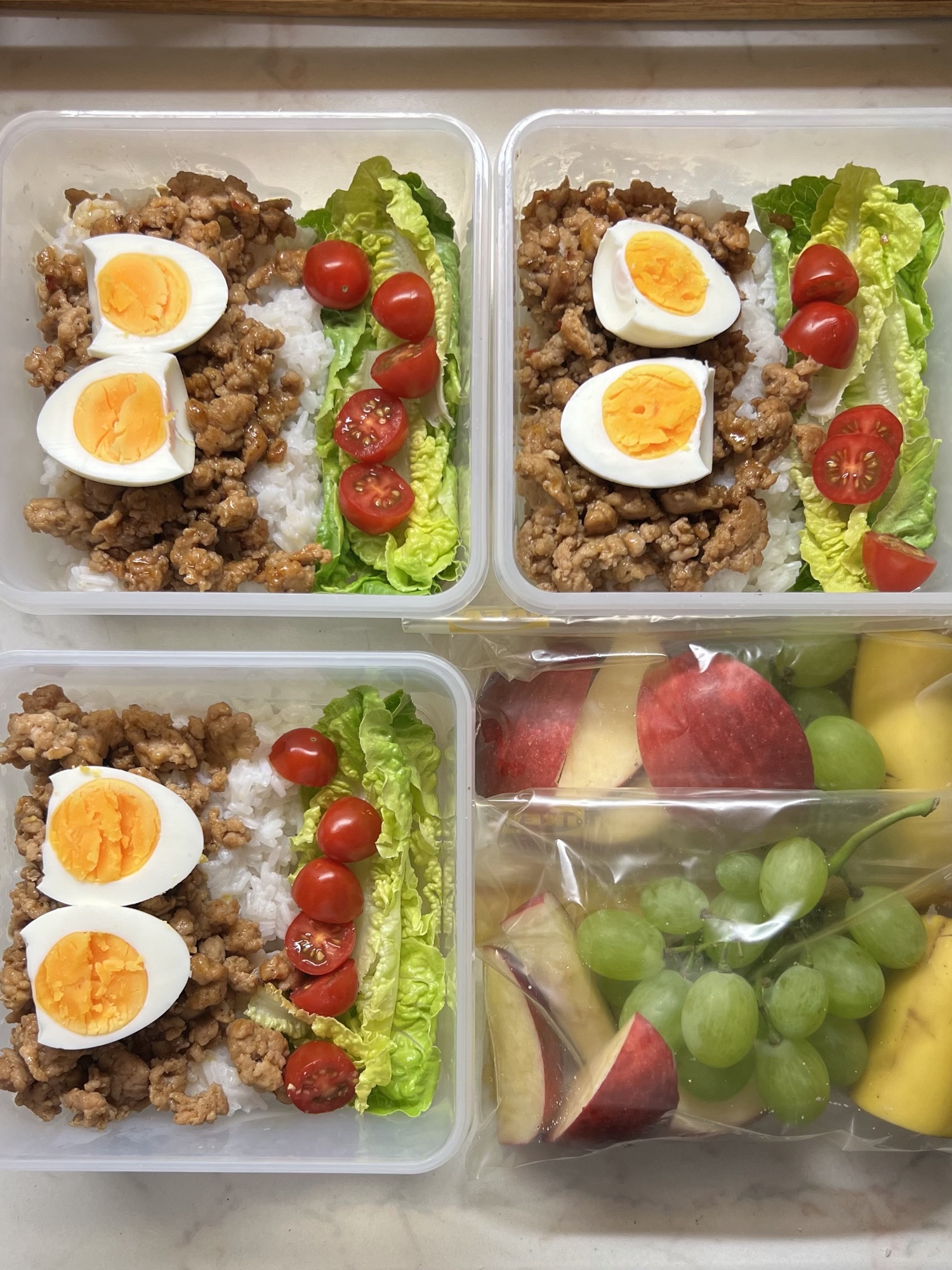
No cooking, no assembly beyond pulling components out of prepped containers. A hard-boiled egg, cheese cubes, whole-grain crackers, cherry tomatoes, grapes, and a few pretzel rods. I boil eight eggs on Sunday and they live in the fridge all week. Total assembly time is about three minutes at 7:20 in the morning.
Thursday: Turkey pinwheel wraps
Tortilla, hummus or cream cheese alternating weeks, two slices of turkey, rolled tight and sliced into rounds. Plus baby carrots, banana, and yogurt portioned out from the big tub into a small reusable container.
Repackaging yogurt from the 32-ounce tub into reusable containers saves about $0.60 per serving versus single-serve cups. Over the school year that adds up to $100 or more per child back in the budget.
Friday: Thermos hot lunch
Whatever Thursday night’s dinner was, packed into a preheated thermos.
Preheating with boiling water for five minutes before adding hot food is the single technique that determines whether lunch arrives hot or lukewarm. Pasta, chili, soup, beans and rice, fried rice all work well. What does not work: anything that needs to stay crispy.
The Five Dinners That Power the System
Lunches and dinners need to be planned together. Every dinner I cook is designed to throw off at least one lunchbox component for the next day. This is the part most $100-a-week plans miss.
Sunday: Roast chicken with potatoes and carrots
The $6.95 whole chicken feeds the family for dinner and gives me two cups of shredded meat for Wednesday’s bento protein. The carcass goes into the slow cooker overnight for broth. Potatoes and carrots roast alongside with olive oil and salt.
Monday: Spaghetti with turkey marinara
One pound of ground turkey, one jar of marinara, one pound of pasta. Fast, filling, and the leftovers become Friday’s thermos lunch.
Tuesday: Black bean quesadillas with rice
Two cans of black beans, cheese, tortillas, and leftover rice. Vegetarian, under fifteen minutes, and the leftovers reheat perfectly.
Wednesday: Chicken fried rice
Leftover Sunday chicken, leftover rice, frozen mixed veggies, scrambled egg, and soy sauce. Cook time is about twelve minutes. Throws off Thursday’s thermos lunch.
Thursday: Loaded baked potato bar
Russet potatoes, leftover black beans or chili, shredded cheese, plain yogurt in place of sour cream, steamed broccoli on the side. Costs under four dollars to feed all four of us.
Friday: Flexible night
Leftovers, scrambled eggs, or peanut butter toast. This is a deliberate pressure-release valve and every honest budget meal plan needs one.
The Sunday Prep Routine (90 Minutes)
The system only works because of what happens on Sunday. I time myself most weeks and it lands between 75 and 100 minutes.
The chicken goes into the oven the moment I get home from the store. While it roasts, I wash and dry all the produce, portion grapes into five small containers, cut cucumber spears, slice cheddar for Monday’s DIY lunchable, and boil eight eggs.
The PB&J sandwiches are last because bread spreads better at room temperature. I label five small bags or containers Monday through Friday and pre-load each with the day’s portioned grapes, carrots, and any dry components.
By the time the chicken comes out of the oven, the week’s lunches are essentially pre-assembled. On Tuesday morning all I am doing is pulling that day’s container out of the fridge, dropping it into the lunchbox, and adding an ice pack.
Lunchables vs. DIY: The Real Math
A $1.00 Walmart value-pack Lunchable is, strictly on unit cost, competitive with some homemade lunches when you account for your time. That is worth saying honestly because I do not think buying Lunchables is a moral failing.
What makes the DIY version a clear winner is the savings at volume. The Walmart Turkey and Cheddar Protein Pack at $1.87 versus a DIY equivalent at roughly $1.15 to $1.30 yields about $0.55 to $0.70 in savings per lunch. At five lunches a week for thirty-six school weeks per child, that is $200 to $300 per kid per year. Two kids over three years is a meaningful number.
The bigger wins are also nutritional: more real cheese, better bread, fresh fruit alongside, and more food overall. A packaged Lunchable does not fill a nine-year-old. The bigger loss is time and decision fatigue, which is exactly why I always keep a small stash of $1 Lunchables in the fridge for the morning everything goes sideways and Sunday prep did not happen.
Where the Budget Leaks (And How to Plug It)
The most expensive things in a school lunch per ounce are almost always single-serve packaging. A 4-ounce yogurt cup costs roughly 70 percent more per ounce than the same yogurt in a 32-ounce tub. Individual chip bags, Capri Sun pouches, snack-pack pudding, pre-cut fruit cups, and single granola bars all carry similar markups.
The items that keep this budget intact are: peanut butter at about $0.10 per tablespoon serving, bread at about $0.07 per slice, bananas at about $0.33 each from a three-pound bag, block cheese sliced at home, and eggs. A complete four-component lunchbox built entirely from these staples runs $1.00 to $1.30 per lunch. That is the floor, and it is a real number.
How to Track It Without Losing Your Mind
One thing that changed how intentional I am with this budget is having somewhere to see it. I log every grocery trip, including back-to-school hauls, in the Cozy Grocery Planner, a Google Sheet I built to track my spending by category and by store. The school-year budget shift is real and it shows up clearly in the dashboard once you start tracking.
The price-tracking tab is where I see patterns like whether Aldi or Walmart is consistently cheaper for the items I buy most during back-to-school season. Grapes, string cheese, and yogurt all move in price across the school year. Having that logged means I am not guessing when to stock up.
The Picky Eater Problem, Honestly
Do not use school lunch to introduce new foods. That is the consistent advice from pediatric dietitians and it is the one I ignored my first year of packing lunches before I learned the hard way. Kids have twenty-two minutes to eat in a loud cafeteria surrounded by friends. New or unfamiliar food almost always comes home uneaten in those conditions.
The lunchbox should be roughly 80 percent safe, familiar foods. If a lunch comes home untouched, ask which of the likely culprits it was before you change the menu: too much food, a container the kid cannot open, social distraction, or a temperature issue. More often than not it is one of those and not the food itself.
The one practical thing that consistently improves how much my kids eat from their lunchboxes is letting them help pack the night before. Ownership makes a real difference.
A Four-Week Rotation to Prevent Boredom
Kids actually tolerate repetition better than adults do. Predictability reduces lunchtime anxiety for many elementary-age kids, which is reassuring when you are packing the same five things on rotation. But around week three most parents hit a wall where the same PB&J starts coming home untouched.
My fix is a soft rotation by week type:
- Week 1: Sandwich week (PB&J, turkey, ham and cheese)
- Week 2: Wrap and roll week (pinwheels, hummus wraps, banana tortilla rolls)
- Week 3: Snacky bento week (no sandwich at all: egg, cheese, crackers, fruit, and veggie variations
- Week 4: Thermos week (hot leftovers, soup, pasta, rice bowls), cheese, crackers, fruit, veggie variations)
- Week 4: Thermos week (hot leftovers, soup, pasta, rice bowls)
Theme days help too. Thermos Thursday is always a hot lunch. Snacky Wednesday is always a no-cook bento. Shape removes the daily decision from the equation.
The Goal Is Repeatability, Not Beauty
My first year of packing school lunches I was trying to make Pinterest-worthy bento boxes. By Halloween I had quit.
The goal is not beauty. The goal is a system you will actually maintain on a Wednesday night after a full day when you are tired and you still need tomorrow’s lunch ready by 7:30 a.m.
The $100 week works because the same twenty ingredients do the same rotating jobs every week. The DIY Lunchable saves $250 per kid per year.
The frozen PB&Js save the morning. The thermos saves leftovers from going to waste. Stack those and the budget holds. Stop treating every lunch as its own problem to solve and start treating the week as one connected system.
Frequently Asked Questions
How do I start packing school lunches on a budget?
Pick four lunchbox components: a protein, a starch, a fruit, and a crunch, and rotate three to five options in each slot. Do a full Sunday prep and you will have most of the week handled before Monday morning starts.
Can you freeze school lunch sandwiches?
Yes. Peanut butter and jelly, deli meat, sliced cheese, and cream cheese all freeze well for up to three months. Spread peanut butter on both slices of bread before adding jelly to keep the bread from getting soggy. A frozen sandwich packed in the morning thaws by lunch and acts as an ice pack while it does.
How much does it cost to pack a school lunch?
A four-component lunchbox made with store-brand staples from Aldi or Walmart costs about $1.00 to $1.30 per lunch. Lunchables at Walmart range from $1.00 for the value pack to $2.86 for the Cracker Stackers version. Over a full school year the DIY version saves $200 to $300 per child.
What are easy school lunches kids will actually eat?
The DIY Lunchable, peanut butter and jelly with apple slices, a snacky bento with egg and cheese and crackers, turkey pinwheel wraps, and a thermos of last night’s pasta or soup. Stick to foods your child already knows at school. Save new foods for home.
How do I keep packed lunches cold until lunchtime?
An insulated lunch bag plus one ice pack handles four hours reliably. A frozen PB&J acts as a second ice pack and thaws in time for lunch. Items most sensitive to temperature like deli meat, cut fruit, and cooked rice or potatoes should always travel with a cold source.
Is it cheaper to pack lunch or buy school lunch?
In states with universal school meals, buying is free and nothing beats that. Where lunch costs $2.50 to $3.50 per day, packing at $1.20 per lunch saves about $6.50 per child per week. Across a full school year that is $230 or more per kid in savings.

Cynthia Odenu-Odenu is the founder of Cyanne Eats. A registered nurse with a passion for food, she brings the same attention to detail from her professional life into the kitchen. From chain restaurant rankings to grocery finds and easy recipes, Cynthia covers it all and helps everyday food lovers eat better and spend smarter.